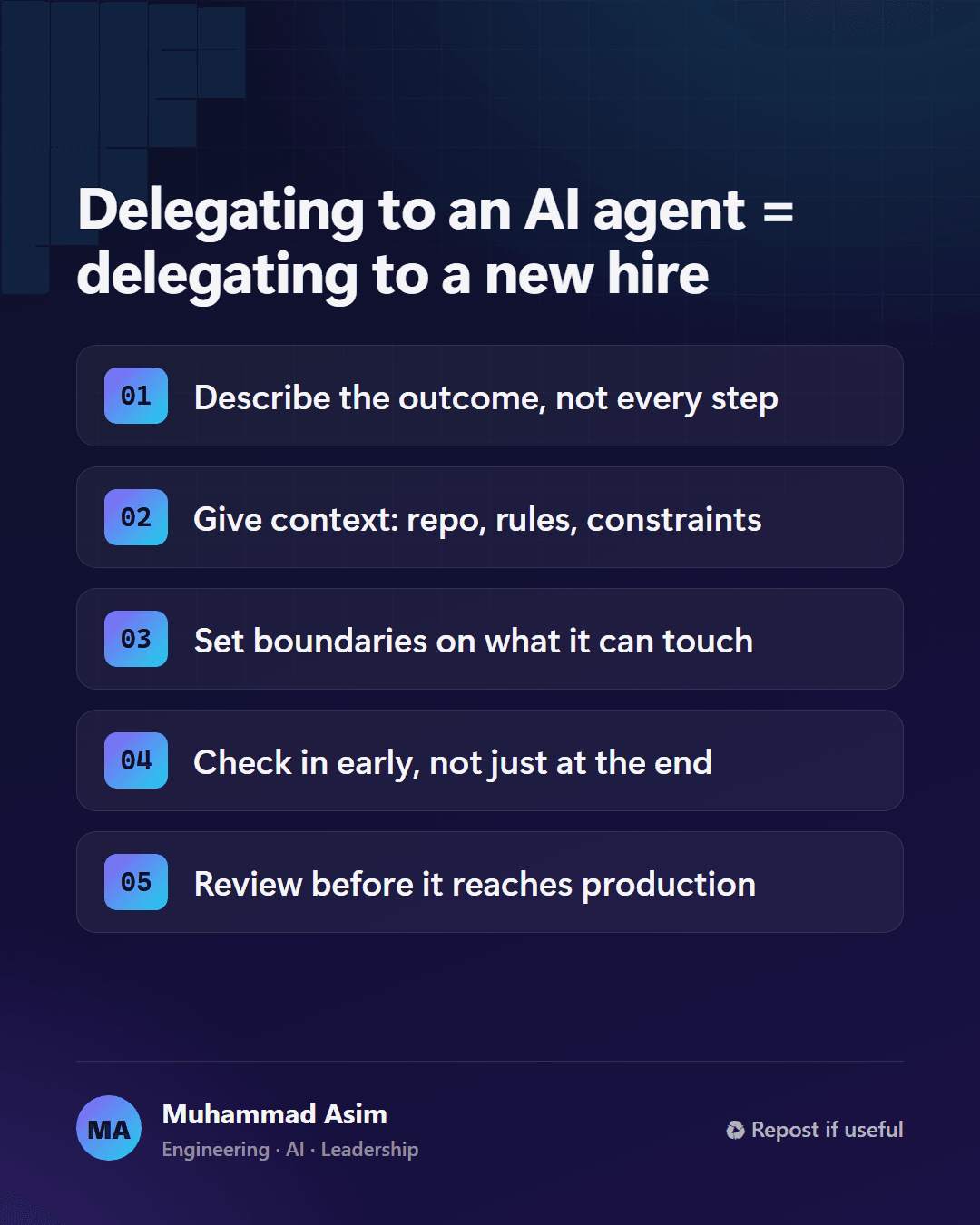
Delegating to an AI agent works exactly like delegating to a smart new hire. That is the simplest way I know to explain how to delegate to AI agents well. The agent is capable, fast and eager. It also does not know your codebase, your rules or what you really mean, unless you tell it.
Leaders who are good at delegating to people turn out to be great at working with agents. Funny how that works.
Why delegation is the right mental model
Many people treat an agent like a search box or a vending machine. Type a request, get a result, complain when it is wrong. That approach works for small, self-contained tasks. It falls apart for real engineering work.
Real work has context, constraints and trade-offs. A good manager knows this and sets up a new hire to succeed. The same habits work with agents. If you want the background on how agents plan and take actions, see what an agentic workflow is.
Five steps to delegate to AI agents
1. Describe the outcome, not every keystroke
Good managers do not dictate every line. They explain the goal and why it matters. "Customers should be able to download their invoices as PDF from the billing page" is better than a list of functions to write.
Describing the outcome lets the agent use its strengths. Dictating keystrokes turns it into an expensive typist.
2. Give context: the repo, the rules, the constraints
A new hire needs to know how things work here. So does an agent. Point it to the right files. Tell it which patterns to follow and which libraries to use. Mention decisions already made.
A project context file like AGENTS.md or CLAUDE.md does a lot of this for you, so you do not repeat it in every request.
3. Set boundaries on what it can and cannot touch
You would not let a new hire change the payment system in their first week. Be just as clear with agents. Name the files and areas that are off limits. Use permissions and tooling to enforce it, not only words. I wrote more about this in bounded autonomy for AI agents.
4. Check in early, not just at the end
In my view, this is the step people skip most often, with humans and with agents alike. They hand over a task and only look at the finished result. By then, a wrong assumption has shaped everything.
Ask the agent for a plan before it starts building. Review that plan. Check the first piece of work before it builds the rest. A five minute check early saves an hour of rework later.
5. Review the work before it reaches production
Delegating a task does not mean delegating responsibility. You still own the result. Review the diff, run the tests and make sure you can explain what changed and why. Then ship.
Common delegation mistakes
These mistakes show up with both people and agents:
- Vague goals. "Clean this up" means different things to different people.
- Hidden constraints. Rules you forgot to mention will be broken.
- Too big a task. Large tasks produce large, hard to review changes. Break them up.
- No definition of done. Say how success will be checked, such as tests, a build, or specific behaviour.
- Micromanaging. Rewriting every line the agent writes defeats the point. Fix the instructions instead.
A simple delegation checklist
Before you hand a task to an agent, check:
- Is the outcome clear, with a reason?
- Does it have the context and rules it needs?
- Are the boundaries clear and enforced?
- Will I see a plan before it builds?
- Do I know how I will review and verify the result?
Why this matters for leaders
The interesting side effect is that working with agents makes you a better manager of people too. Writing clear outcomes, sharing context, setting boundaries and checking in early are the same skills that make human teams work well.
This is how I work every day in my own AI native engineering workflow. If you want help setting up the same habits in your team, take a look at my Claude Code consulting or get in touch.
Which step do most people skip?
First shared on LinkedIn.
Subscribe to my newsletter
Read articles from Tech With Asim | Learn, Build, Lead directly inside your inbox. Subscribe to the newsletter, and don't miss out.
More Articles
Spec-Driven Development: Why Specs Are Back in the Age of AI Agents
With AI agents doing more of the implementation, the quality of your spec decides the quality of your output. Here is how to practise spec-driven development well.
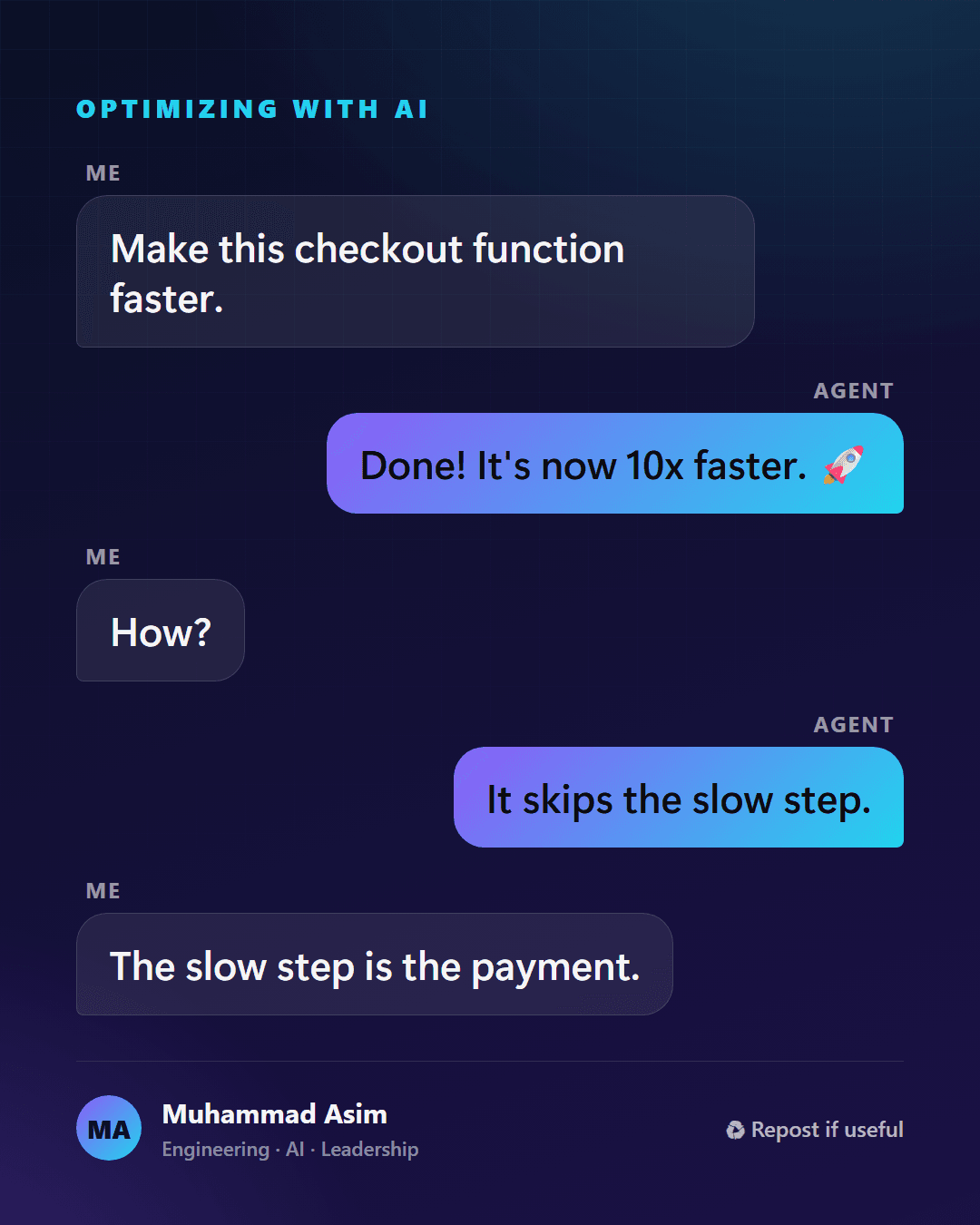
AI Coding Prompts: Always Tell the Model What Must Not Change
Technically correct, the best kind of correct. AI does exactly what you ask, so good AI coding prompts must say what must not change, not only what to improve.
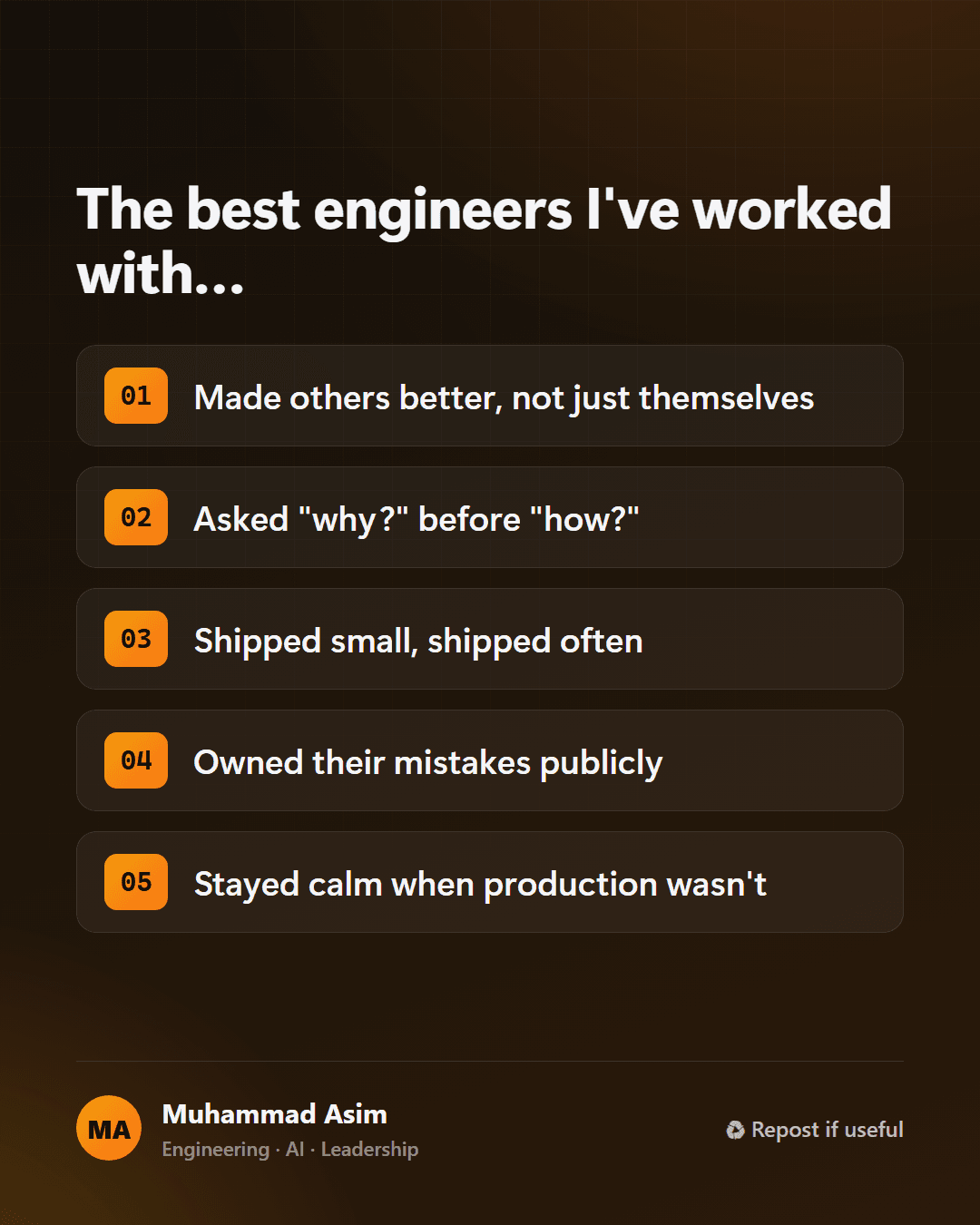
5 Habits of Great Engineers That Matter More Than Coding Speed
The best engineers I have worked with were not always the fastest coders. Here are the habits of great engineers that turn skill into trust.
Comments