Bounded Autonomy for AI Agents: Freedom Inside Clear Walls
One of the big ideas of 2026 is bounded autonomy for AI agents. The idea is simple. Give agents real freedom to do useful work, but only inside clear walls. Agents are no longer just autocomplete. They open pull requests, run commands, call APIs and touch data. That is powerful, and it is also exactly why the walls matter.
I like to compare it to hiring. We would never give a new hire root access on day one. We give them a laptop, a scoped account, a buddy and a few small tasks. Trust grows as they show good judgement. Agents deserve the same onboarding.
Why agents need walls, not cages
There are two common mistakes. The first is the cage: the agent can only suggest, and a human copies every change by hand. You get safety, but you lose most of the value. The second is the open field: the agent has broad credentials and nobody checks what it does until something breaks.
Bounded autonomy sits in the middle. Inside the walls, the agent moves fast and needs no permission. At the walls, it stops and asks. The skill is in deciding where the walls go. If you are new to how agents plan and act in loops, my short explainer on what an agentic workflow is is a good starting point.
The five walls I look for
These are the guardrails I would expect in any serious agent setup.
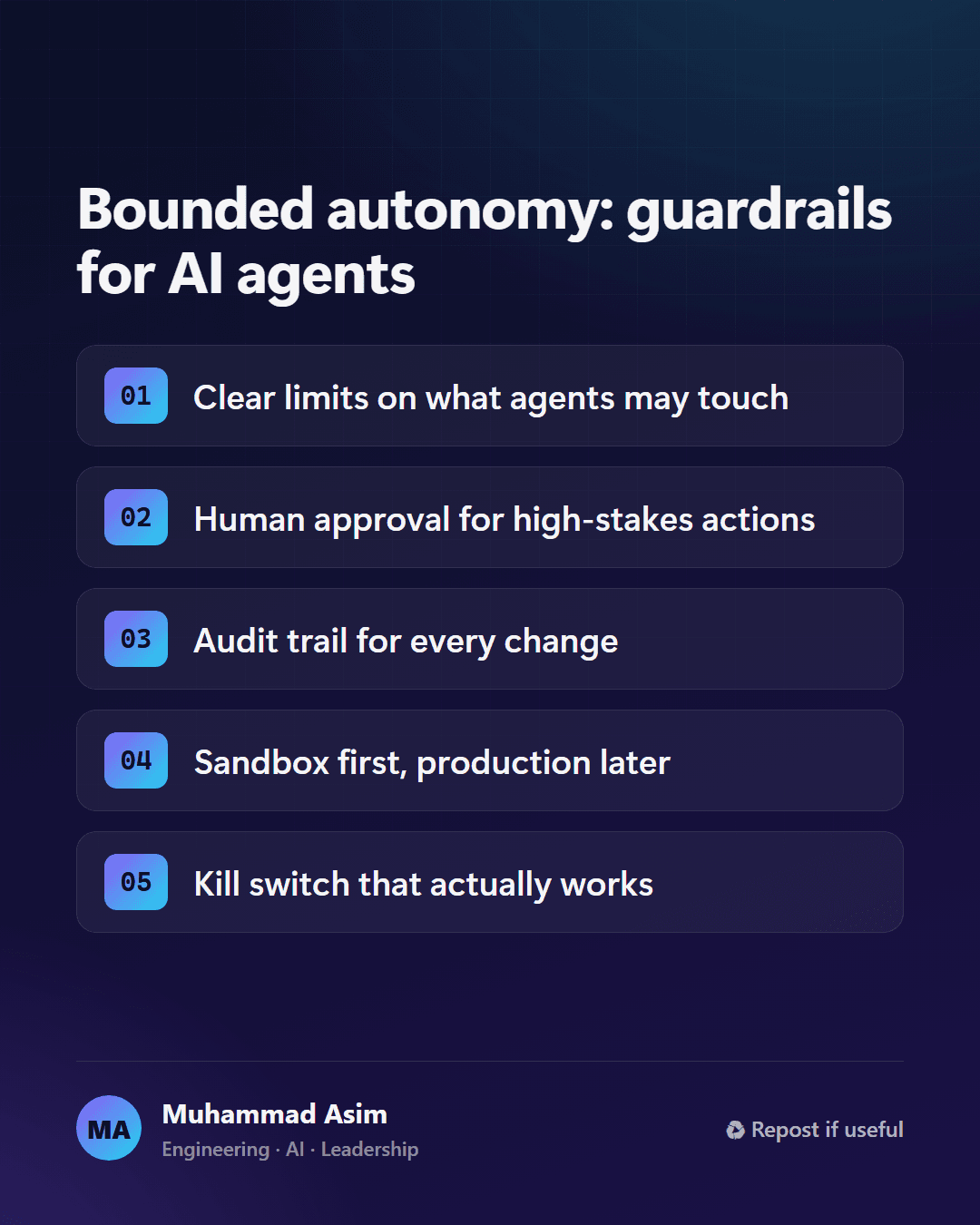
1. Clear limits on what it can touch
Give the agent the smallest set of permissions that lets it finish the job. Scope it to one repo, one folder or one service. Use read-only tokens where reading is enough. Keep production secrets out of its environment completely. If an agent can only see what it needs, a bad decision stays small.
2. Human approval for high-stakes actions
Some actions should always pause for a person. Payments, data deletion and production deploys are the obvious ones. Others depend on your business: sending email to customers, changing pricing, or editing access rules. Write the list down. Make the approval step part of the tool itself, not a polite request in the prompt. Prompts can be ignored. A blocked API call cannot.
3. An audit trail for every change
Every action an agent takes should be logged: what it ran, what it changed, and why it thought that was right. Commits with clear messages, tool call logs and linked tickets all help. When something odd happens, you want to replay the story, not guess it. Audit trails also build trust with the rest of the company. People relax when they can see what the agent did.
4. Sandbox first, production later
New agents, new tools and new prompts should start in a sandbox. Use a copy of the repo, a test database or a staging account. Watch how the agent behaves for a while. Only then let it near anything real. This is the same path we follow for human changes: local, then staging, then production.
5. A kill switch that actually works
Every team says they can stop an agent. Fewer have tested it. A real kill switch revokes credentials, stops running jobs and prevents new ones from starting. It should be one action, not a hunt across five dashboards. Test it on purpose, the same way you test a backup restore.
How to roll out bounded autonomy for AI agents
You do not need a big platform to start. A practical path looks like this:
- List the actions. Write down everything your agents can do today, from reading files to deploying code.
- Sort by risk. Mark each action as safe, needs review, or needs approval.
- Enforce in tooling. Put limits in permissions, hooks and CI, not only in instructions.
- Log by default. Make sure every tool call leaves a trace someone can read.
- Widen slowly. When an agent has a clean track record on a task, give it a little more room.
This is the same thinking I apply in my own AI native engineering workflow. Agents do a lot of the hands-on work, and the guardrails are what make that safe to scale.
Common pitfalls
A few patterns come up again and again.
- Rules only in the prompt. "Never delete data" in a system prompt is a hope, not a control.
- Shared credentials. If the agent uses a human's token, you cannot tell who did what.
- Approval fatigue. If every small step needs a click, people approve without reading. Keep approvals for actions that matter.
- No owner. Someone on the team should own the agent's permissions and review them regularly.
The takeaway
Bounded autonomy for AI agents is not about distrust. It is about giving agents a safe place to earn trust, exactly as we do with people. Clear limits, human approval for high stakes, a full audit trail, sandbox first and a kill switch that works. Get those five right, and you can let agents move fast without losing sleep.
If you want help designing these guardrails for your team, take a look at my Claude Code consulting work or get in touch.
How is your team putting guardrails around AI?
First shared on LinkedIn.
Subscribe to my newsletter
Read articles from Tech With Asim | Learn, Build, Lead directly inside your inbox. Subscribe to the newsletter, and don't miss out.
More Articles
Spec-Driven Development: Why Specs Are Back in the Age of AI Agents
With AI agents doing more of the implementation, the quality of your spec decides the quality of your output. Here is how to practise spec-driven development well.
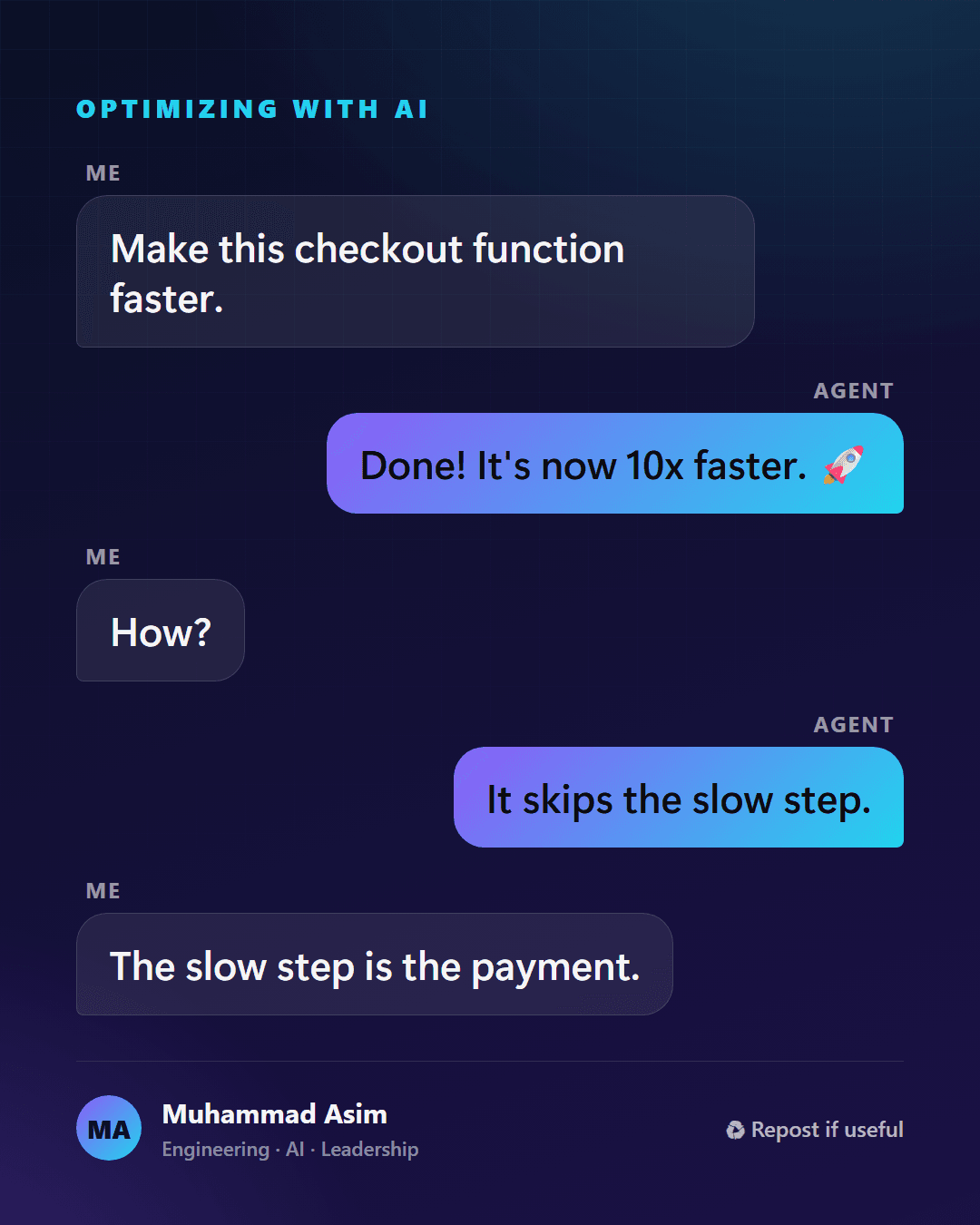
AI Coding Prompts: Always Tell the Model What Must Not Change
Technically correct, the best kind of correct. AI does exactly what you ask, so good AI coding prompts must say what must not change, not only what to improve.
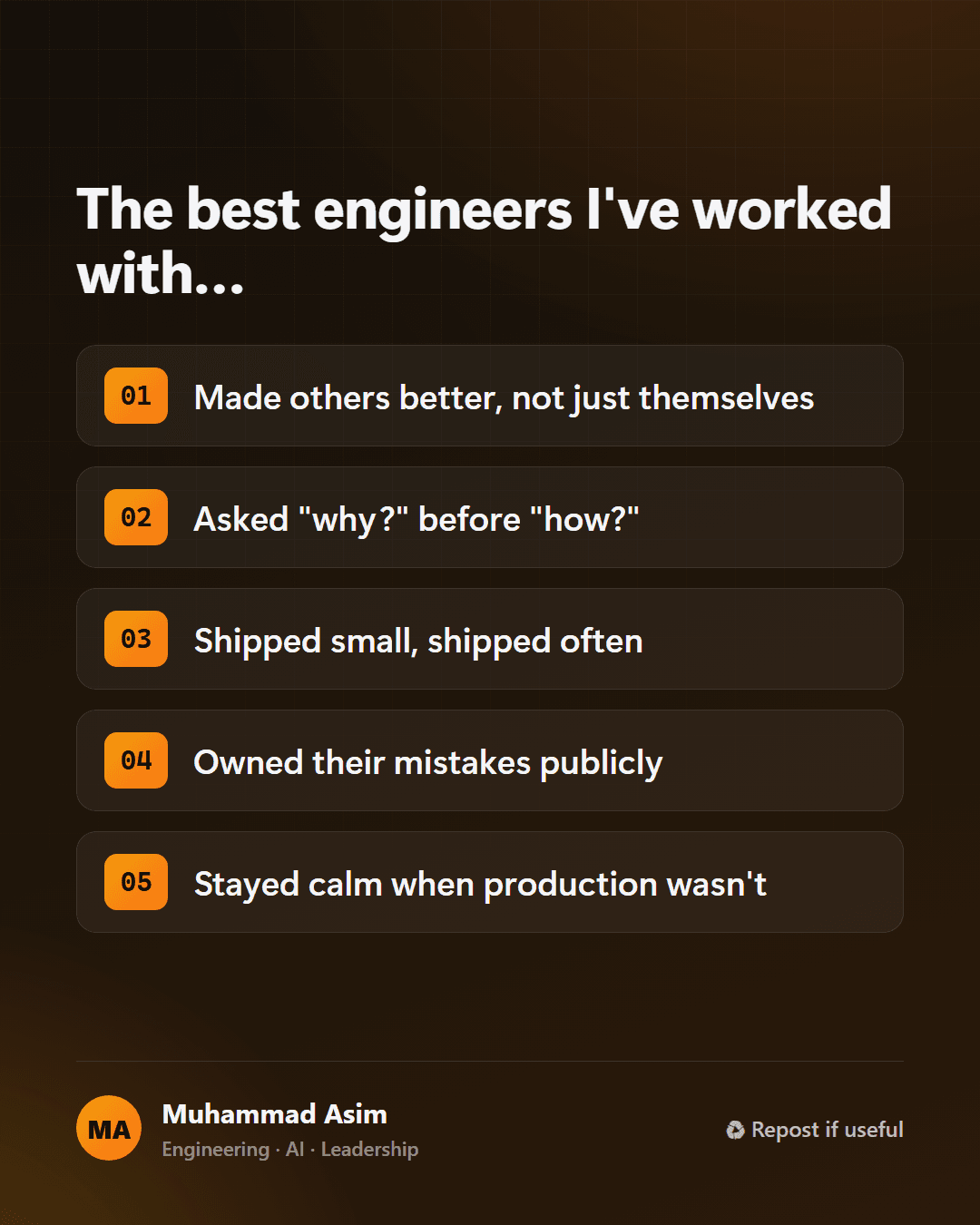
5 Habits of Great Engineers That Matter More Than Coding Speed
The best engineers I have worked with were not always the fastest coders. Here are the habits of great engineers that turn skill into trust.
Comments