Clear Writing Is the New Programming: Writing Specs for AI Agents
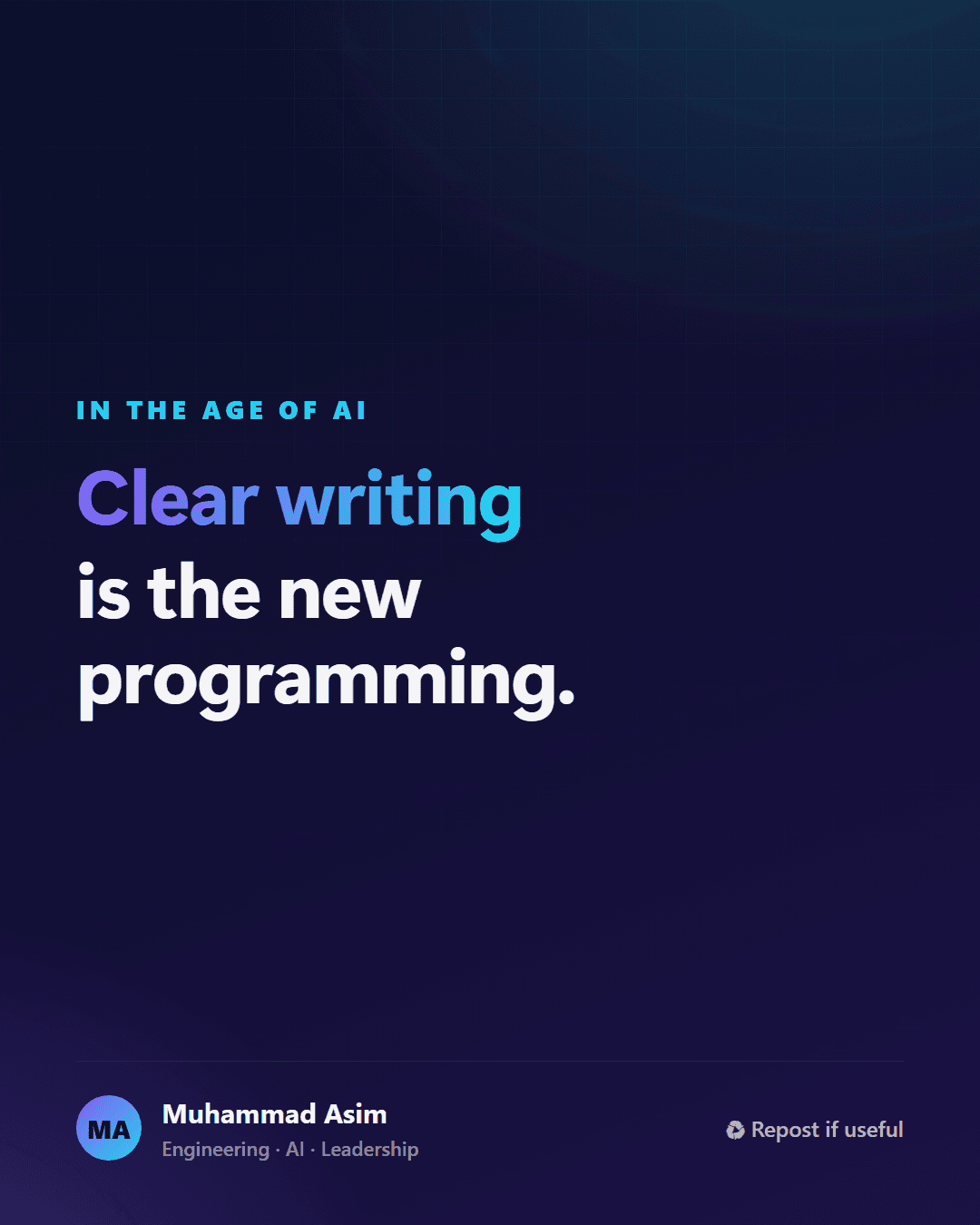
In the age of AI, clear writing is the new programming. That is the main lesson I have taken from working with AI coding agents every day, and it is why writing specs for AI agents has become one of the most useful skills on any engineering team.
Think about it this way:
- Your prompt is your code.
- Your spec is your architecture.
- Your acceptance criteria are your tests.
The engineers getting the best results from agents are not the ones with clever tricks or secret prompt templates. They are the ones who can explain clearly what they want, what they do not want, and how to check it. Writing used to be called a "soft skill". Now it is a production skill.
Why writing became a technical skill
When you write code by hand, a vague idea is fine. You fill in the gaps as you type, because the details live in your head. An agent does not have your head. It only has what you wrote, plus whatever it can find in the repo.
So every gap in your request becomes a guess. Sometimes the guess is good. Often it is reasonable but wrong for your system. Then you spend twenty minutes reviewing and correcting code that a clearer paragraph would have prevented.
This is also the honest difference between vibe coding and engineering with AI. Vibe coding is fine for a quick prototype. For production work, the quality of your writing sets the ceiling on the quality of the output.
The three parts of a good spec
When I write a task for an agent, I try to cover three things.
1. What I want
Describe the outcome, not every keystroke. Say who it is for and why it matters. "Add a filter to the orders page so support staff can find refunds from the last 30 days" beats "add a filter".
Include the context the agent cannot guess: which files are involved, which patterns the codebase already uses, and any decision already made.
2. What I do not want
This part is often skipped, and it is where most surprises come from. Name the boundaries:
- Do not change the public API.
- Do not add a new dependency.
- Do not touch the payment module.
- Keep the existing styling system.
A short "out of scope" list saves more time than a long list of features.
3. How to check it
Acceptance criteria are your tests in plain language. Write them so a person, or the agent itself, can verify them:
- The filter shows only refunded orders.
- The default range is the last 30 days.
- Existing tests pass, and there is a new test for the filter.
- The page still loads with an empty result.
If you cannot write how to check it, you are not ready to ask for it.
A simple template you can reuse
Here is the shape I keep coming back to when writing specs for AI agents:
- Goal: one or two sentences on the outcome and why.
- Context: relevant files, patterns, and decisions already made.
- Constraints: what not to change, and any rules to follow.
- Acceptance criteria: a short checklist that proves it works.
- Verification: the exact commands to run, such as tests, lint or a build.
It looks like a lot, but most specs fit in ten lines. The time you spend here is small compared to the time you save in review. I use the same structure across my own AI native engineering workflow, and it is the single habit that improved my results the most.
Common mistakes
A few traps I see often:
- Writing a wish, not a spec. "Make it better" gives the agent nothing to aim at.
- Burying the key rule. Put constraints near the top, not in the last line.
- Mixing many tasks in one request. Split them. Small tasks give clearer results and smaller diffs.
- Skipping the check. Without acceptance criteria, "done" means "the agent stopped".
Writing is now part of the job
The good news is that this skill helps beyond AI. Clear specs make better tickets, better pull request descriptions and better handovers between humans. Teams that write well also onboard faster and argue less.
If you want a broader view of how this fits into modern development, I wrote about it in vibe coding and the future of software engineering. And if you want help building these habits in your team, get in touch.
So here is my honest question: has AI made you a better writer, or exposed that you need to be?
First shared on LinkedIn.
Subscribe to my newsletter
Read articles from Tech With Asim | Learn, Build, Lead directly inside your inbox. Subscribe to the newsletter, and don't miss out.
More Articles
Spec-Driven Development: Why Specs Are Back in the Age of AI Agents
With AI agents doing more of the implementation, the quality of your spec decides the quality of your output. Here is how to practise spec-driven development well.
AI Coding Prompts: Always Tell the Model What Must Not Change
Technically correct, the best kind of correct. AI does exactly what you ask, so good AI coding prompts must say what must not change, not only what to improve.
5 Habits of Great Engineers That Matter More Than Coding Speed
The best engineers I have worked with were not always the fastest coders. Here are the habits of great engineers that turn skill into trust.
Comments