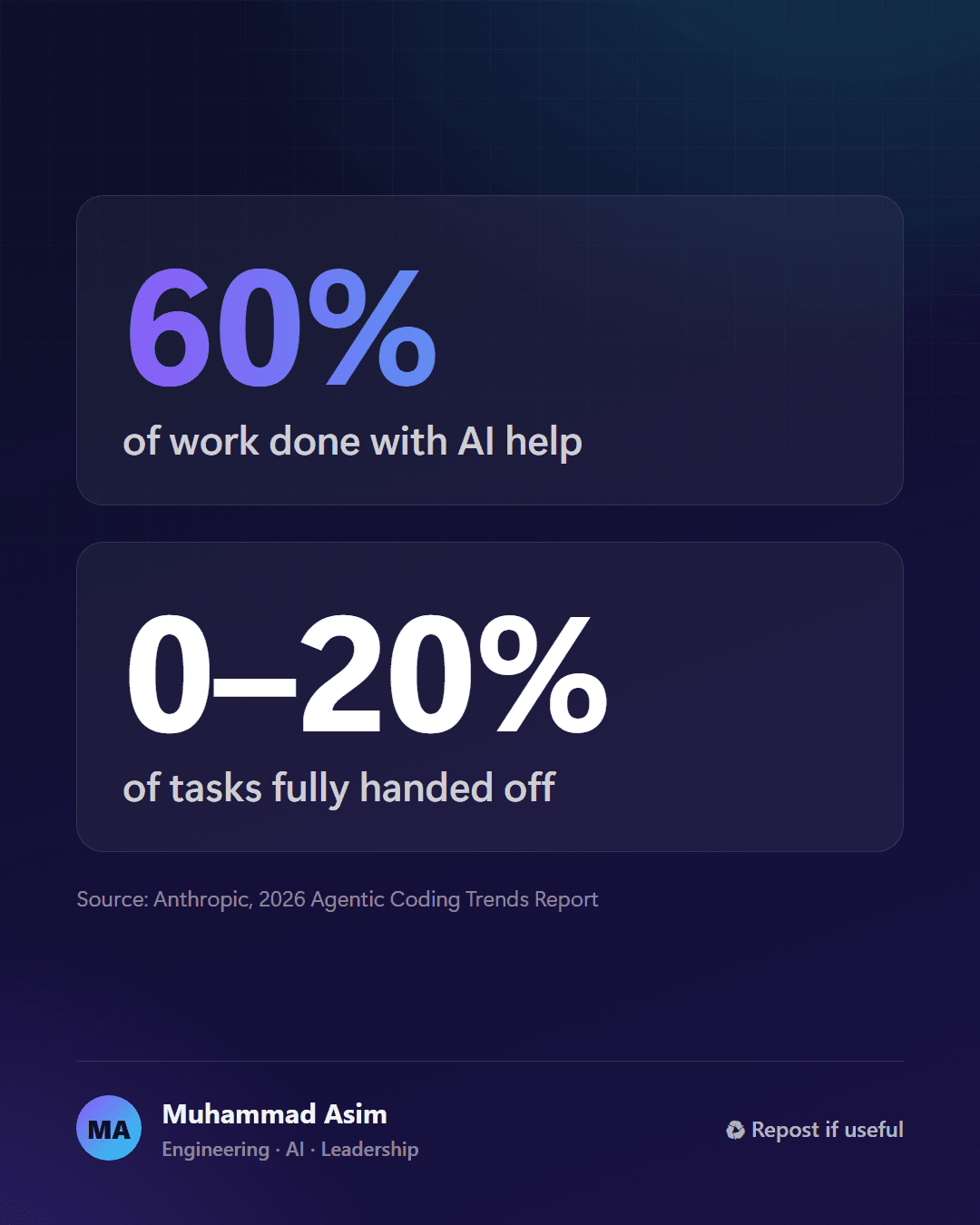
Developers now use AI for around 60% of their work, but can fully hand off only 0 to 20% of tasks (source: Anthropic's 2026 Agentic Coding Trends Report). That gap is the whole story. Knowing what to delegate to AI, and what to keep in your own hands, is quickly becoming one of the most useful skills an engineer can have.
AI is a collaborator, not a replacement. The value is not "AI did it." The value is "AI drafted it, I shaped it, and we shipped it faster."
Using AI is not the same as handing off
Those two numbers describe different things. "Using AI for most of your work" means AI is involved: drafting, explaining, suggesting, searching, testing. "Fully handing off" means you give the task to an agent and accept the result with little or no change.
Most real work sits in the middle. The agent produces a first version. You correct the direction, fix the edge cases, tighten the naming and check that it fits the rest of the system. That middle zone is where most of the value is, and where most of the risk is too.
So the skill to build in 2026 is not "use AI more." It is knowing which 20% you can delegate and which 80% needs you in the loop.
What you can usually delegate to AI
Tasks that are good candidates for a full hand off tend to share a few traits: the goal is clear, the result is easy to check and a mistake is cheap to fix.
- Boilerplate and scaffolding. New components, routes or config that follow an existing pattern.
- Test writing for existing code. Especially when you review the cases it covers.
- Small, well scoped refactors. Renames, extracting a function, updating to a new API.
- Documentation drafts. README sections, code comments, changelog notes.
- Repetitive migrations. The same change applied across many files.
- Explaining code. Summaries of unfamiliar files or modules.
Even here, "delegate" does not mean "never look." It means the review is quick because the task is simple to verify.
What needs you in the loop
Some work should stay shared, with you making the key calls:
- Architecture and design choices. Where data lives, how services talk, what to build at all.
- Security sensitive code. Auth, payments, permissions and anything touching personal data.
- Ambiguous requirements. If the ticket is unclear, the agent will guess. You should ask.
- Performance critical paths. Code that has to scale needs someone who knows how it will be used.
- Production incidents. Agents can help investigate, but the decisions under pressure are yours.
- Anything you cannot verify. If you cannot tell whether the answer is right, you cannot hand it off.
A simple test for any task
Before handing work to an agent, I ask myself four quick questions:
- Can I describe "done" in two or three sentences? If not, the task is not ready to delegate.
- Can I check the result in less time than it takes to do it? If not, the hand off saves nothing.
- What is the cost of a subtle mistake? Low cost means delegate. High cost means stay close.
- Does it follow a pattern that already exists in the codebase? Patterns make agents reliable.
If a task passes all four, I delegate to AI with confidence. If it fails one, I collaborate instead: the agent drafts, I shape. If it fails several, I do it myself and maybe use AI for research or review.
This is the core of an agentic workflow that actually works in practice. You can see how I apply it in my AI native engineering workflow.
Common mistakes
- Delegating vague tasks. Unclear input gives confident but wrong output.
- Reviewing too lightly. Green tests do not mean the right thing was built.
- Never delegating at all. Doing everything by hand leaves real speed on the table.
- Moving the line without noticing. As trust grows, people slowly hand off riskier work without deciding to.
Your line will move over time as tools and your own skill improve. That is fine, as long as you move it on purpose. If you worry about where this is all heading, I shared my thoughts in Is It Possible for AI to Replace You?
The takeaway
The gap between using AI and fully trusting it is not a failure of the tools. It is a description of good engineering. Delegate to AI the work that is clear, checkable and cheap to fix. Stay in the loop for the rest. That balance is what turns AI from a novelty into real delivery speed.
Where is your line between "delegate" and "do it myself"? If you want help finding it for your team, get in touch.
First shared on LinkedIn.
Subscribe to my newsletter
Read articles from Tech With Asim | Learn, Build, Lead directly inside your inbox. Subscribe to the newsletter, and don't miss out.
More Articles
Spec-Driven Development: Why Specs Are Back in the Age of AI Agents
With AI agents doing more of the implementation, the quality of your spec decides the quality of your output. Here is how to practise spec-driven development well.
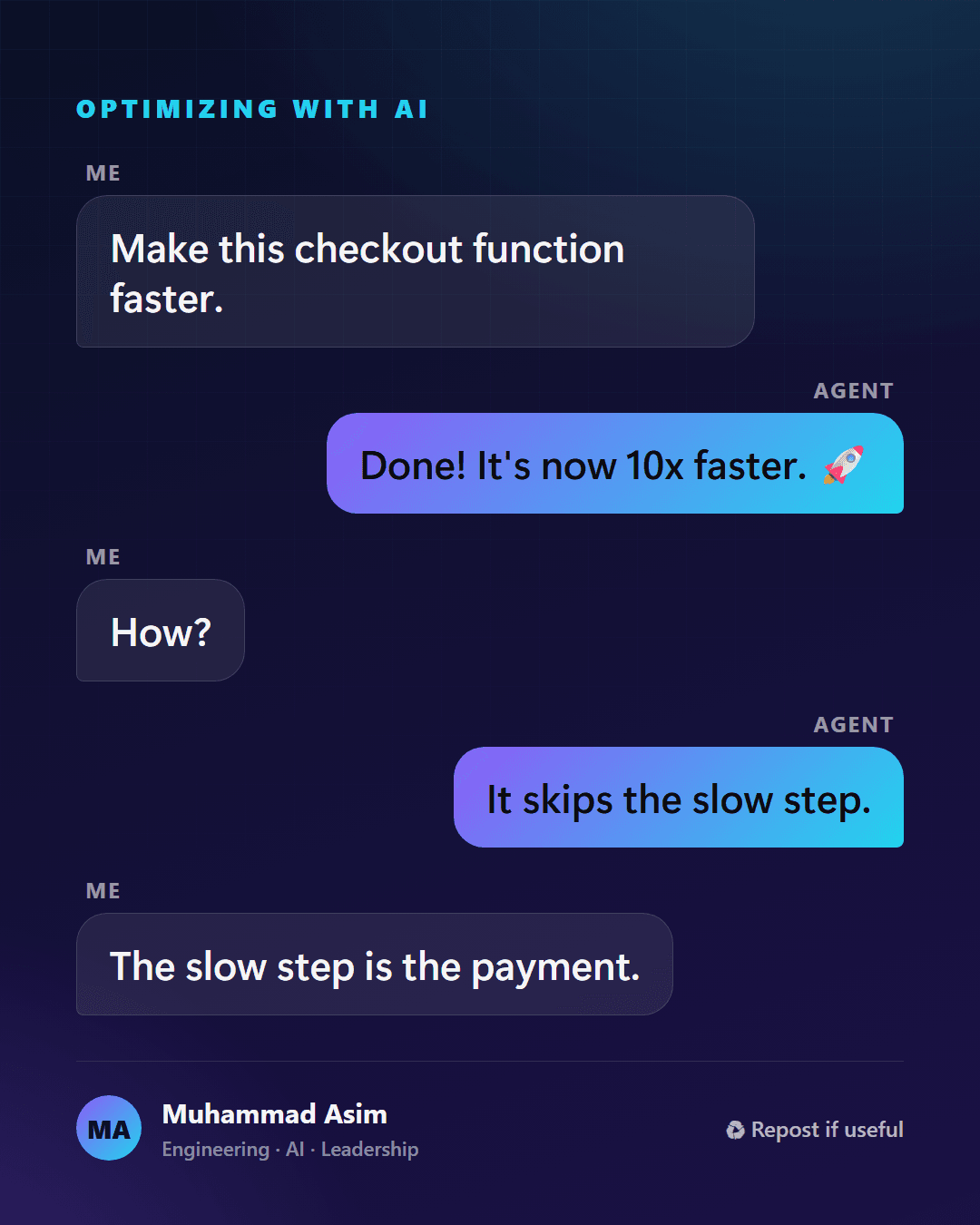
AI Coding Prompts: Always Tell the Model What Must Not Change
Technically correct, the best kind of correct. AI does exactly what you ask, so good AI coding prompts must say what must not change, not only what to improve.
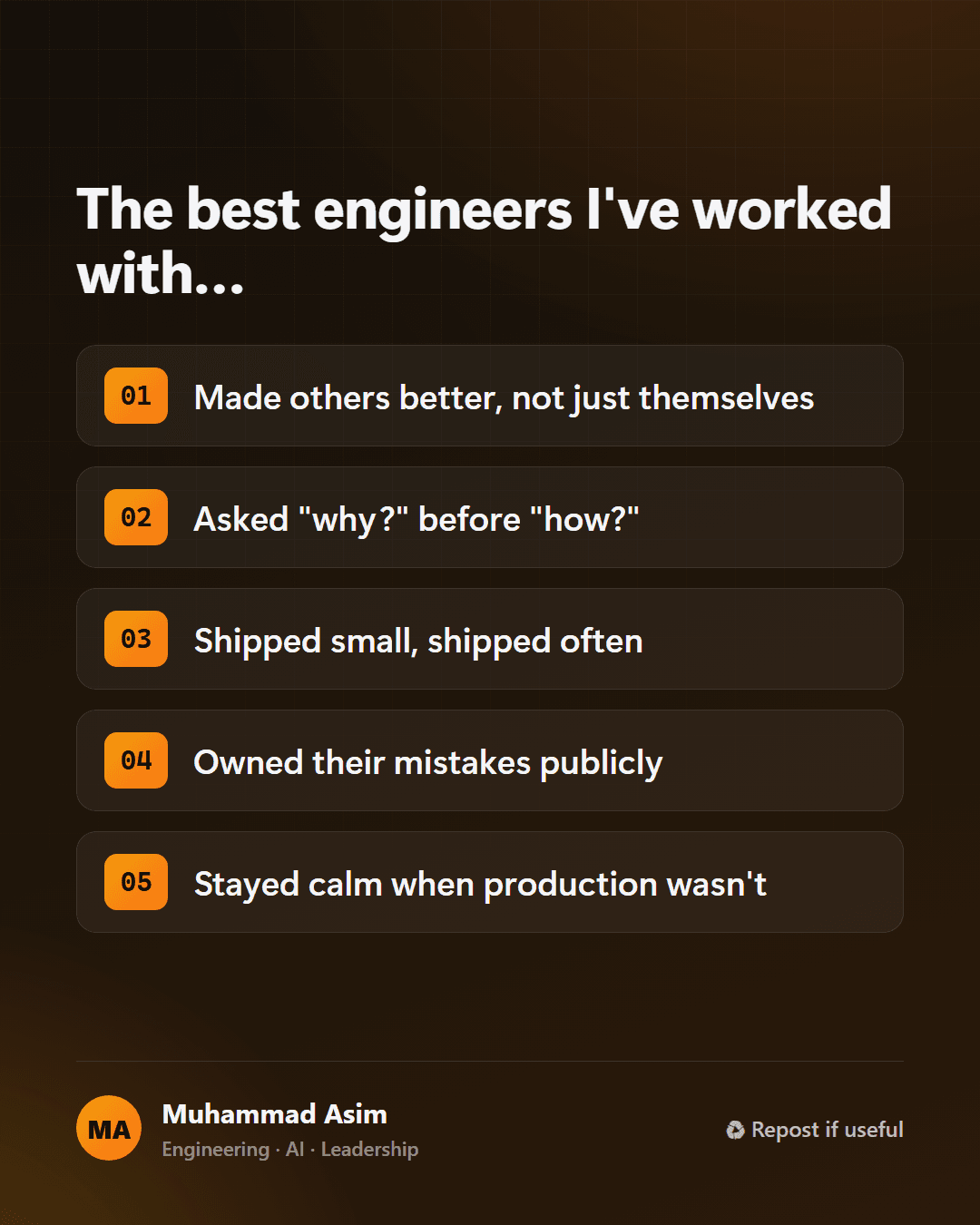
5 Habits of Great Engineers That Matter More Than Coding Speed
The best engineers I have worked with were not always the fastest coders. Here are the habits of great engineers that turn skill into trust.
Comments