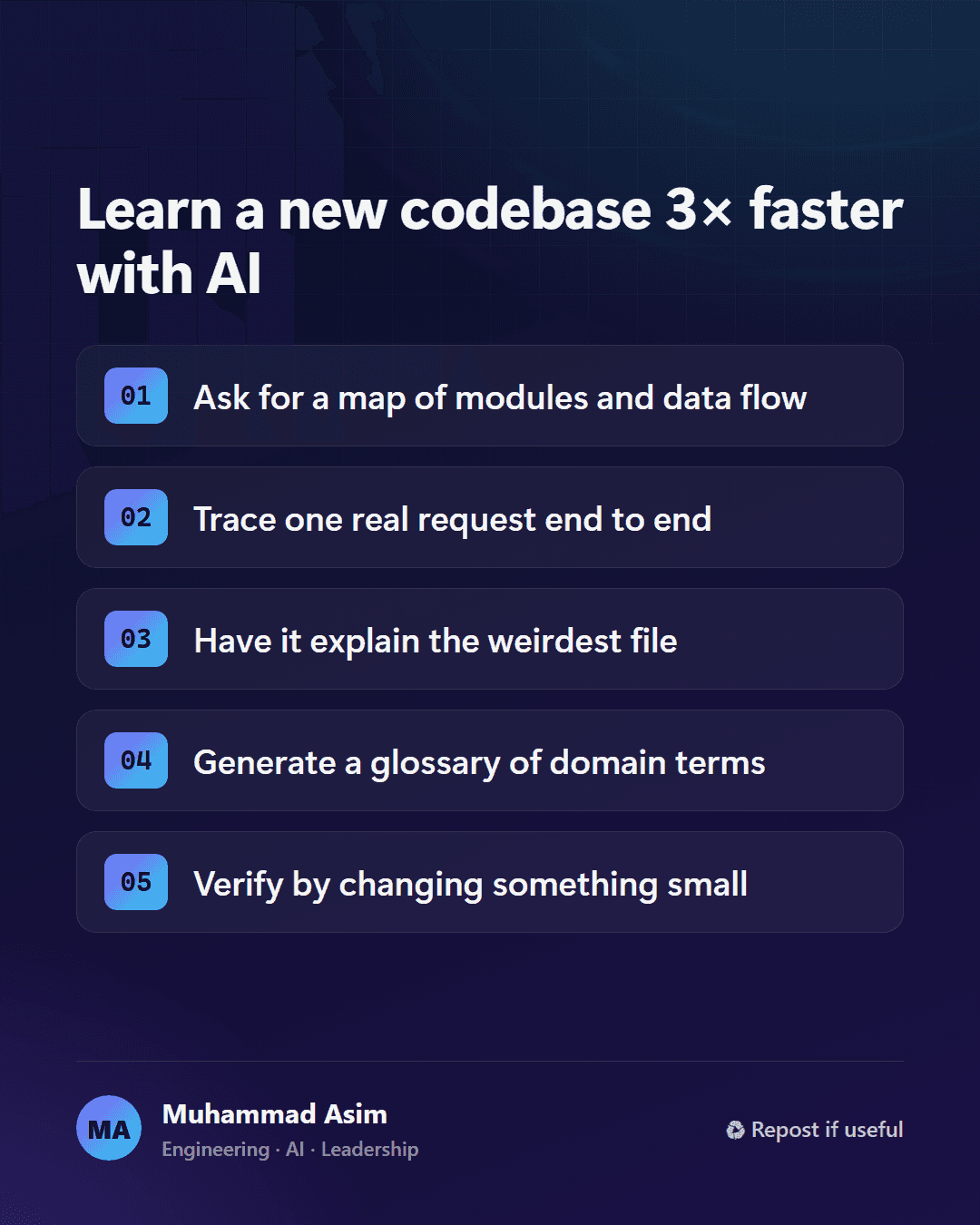
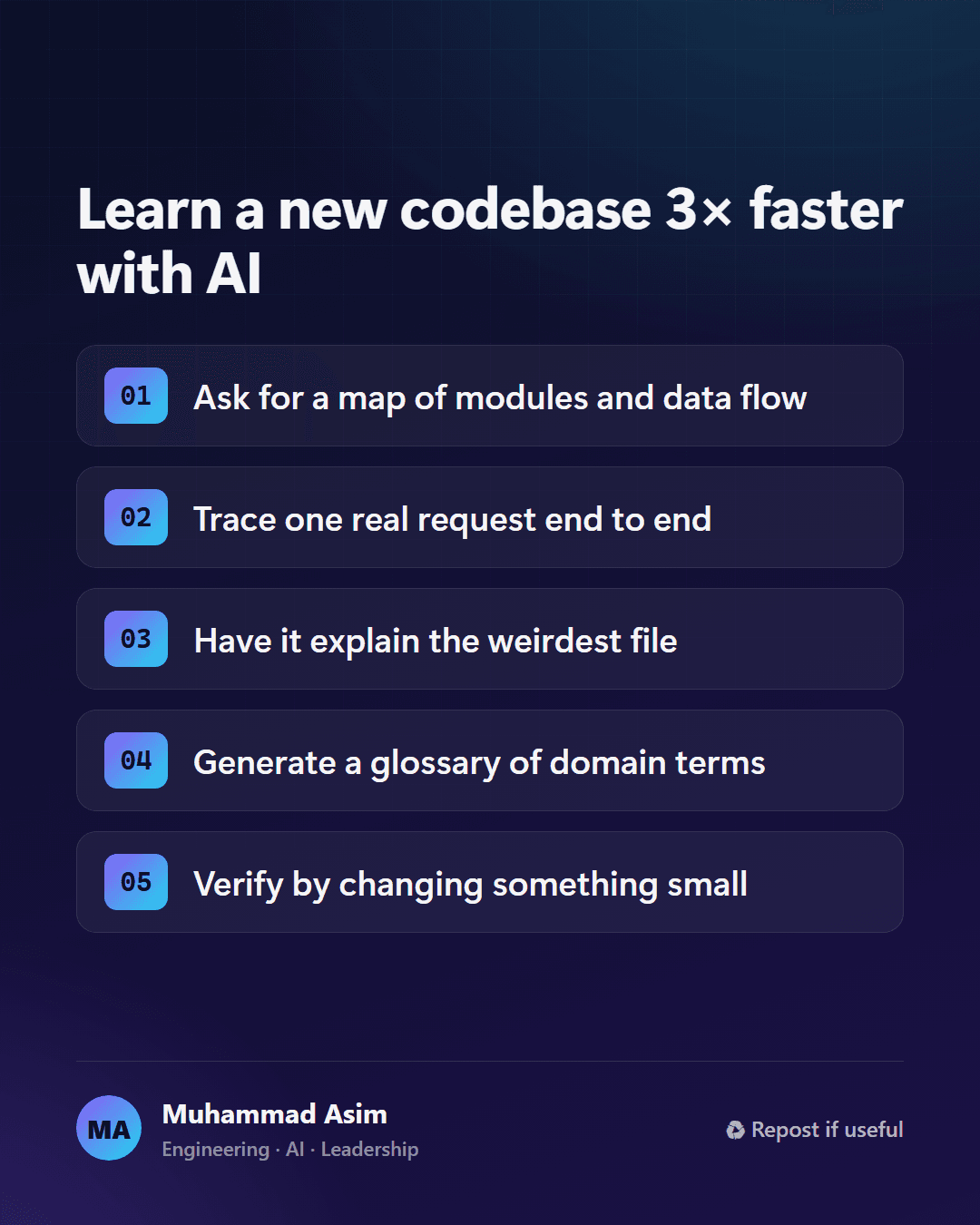
Joined a new team or inherited a legacy codebase? AI is an amazing tour guide. Used well, it can help you understand a legacy codebase in days instead of weeks. Used badly, it gives you confident summaries that you never check.
The goal is not for AI to know the code. It is for you to know it, faster. Here is the process I follow.
Why legacy code is hard to learn
Old codebases carry history. Decisions made years ago for reasons nobody remembers. Patterns from three different eras mixed together. Business rules hidden in odd places. Docs that were correct once. The people who built it may have moved on.
Reading file by file does not work well. You get lost in details before you see the shape of the system. What you need is a map first, then a guided path through it. That is exactly where an AI agent with access to the repo shines.
My five-step process
1. Ask the agent for a map: modules, data flow, entry points
Start wide. Ask the agent to describe the main modules, how they depend on each other, where requests come in and where data is stored. Ask for the entry points: routes, jobs, event handlers, scheduled tasks.
A useful prompt: "Give me a high-level map of this repository. List the main modules, what each one does, the entry points, and how data flows between them. Point to the files that support each claim."
Asking for file references matters. It lets you check the map instead of trusting it.
2. Trace one real request from API to database
A map is abstract. A trace is concrete. Pick one real user action, like "submit an order" or "update a profile," and ask the agent to follow it step by step: the route, the handler, the validation, the business logic, the database calls and the response.
Then open those files yourself and follow along. This single exercise teaches you more about the architecture than hours of reading random files.
3. Ask it to explain the weirdest file
Every repo has one. The giant utility file, the module full of special cases, the function with a scary comment. Ask the agent to explain what it does, why it might be written that way, and what depends on it.
This is where hidden business rules and old workarounds usually live. Understanding them early saves you from breaking something important later.
4. Generate a glossary of domain terms
Legacy systems are full of domain language: product names, internal codes, status values, abbreviations. Ask the agent to find these terms in the code and build a glossary with short definitions and where each one is used.
Then check it with a teammate. Some definitions will be wrong or incomplete, and correcting them is a great way to start real conversations with the team. The finished glossary is also a gift to the next person who joins.
5. Verify by making one small change and running the tests
This is the step that turns information into understanding. Pick a small, safe change, such as a log message, a validation tweak or a minor bug fix. Make it yourself, predict what will happen, then run the tests.
If your prediction was right, your mental model is working. If not, you just found a gap, and that is valuable too.
Pitfalls to avoid
- Trusting summaries without checking. AI can describe code that does not exist or miss a key detail. Always ask for file references and read the important ones.
- Skipping the people. The code tells you what. Teammates tell you why. Use AI to prepare better questions, not to avoid asking them.
- Changing too much too soon. Understanding comes before refactoring. Resist big rewrites in your first weeks.
- Leaking sensitive data. Follow your company's rules on which tools can see which code.
Make it repeatable
Save the useful outputs: the map, the request trace, the glossary. Put them in the repo or the team wiki. Each new person can build on them instead of starting from zero.
This approach fits naturally into an agentic workflow, and it is part of how I ramp up on any new system in my AI native engineering workflow. If you want your team set up to use AI agents this way, my Claude Code consulting covers it, or you can get in touch.
To understand a legacy codebase quickly, let AI guide the tour, but walk every step yourself.
How do you ramp up on unfamiliar code?
First shared on LinkedIn.
Subscribe to my newsletter
Read articles from Tech With Asim | Learn, Build, Lead directly inside your inbox. Subscribe to the newsletter, and don't miss out.
More Articles
claude-manager-kit: Run Your Work Day From One Claude Code Manager Session
An open-source npm package that turns your Claude plan into a manager that triages, delegates to parallel leads and learns from ratings. No API keys.
Thanking the Unsung Heroes of Software Teams (and Making Their Work Visible)
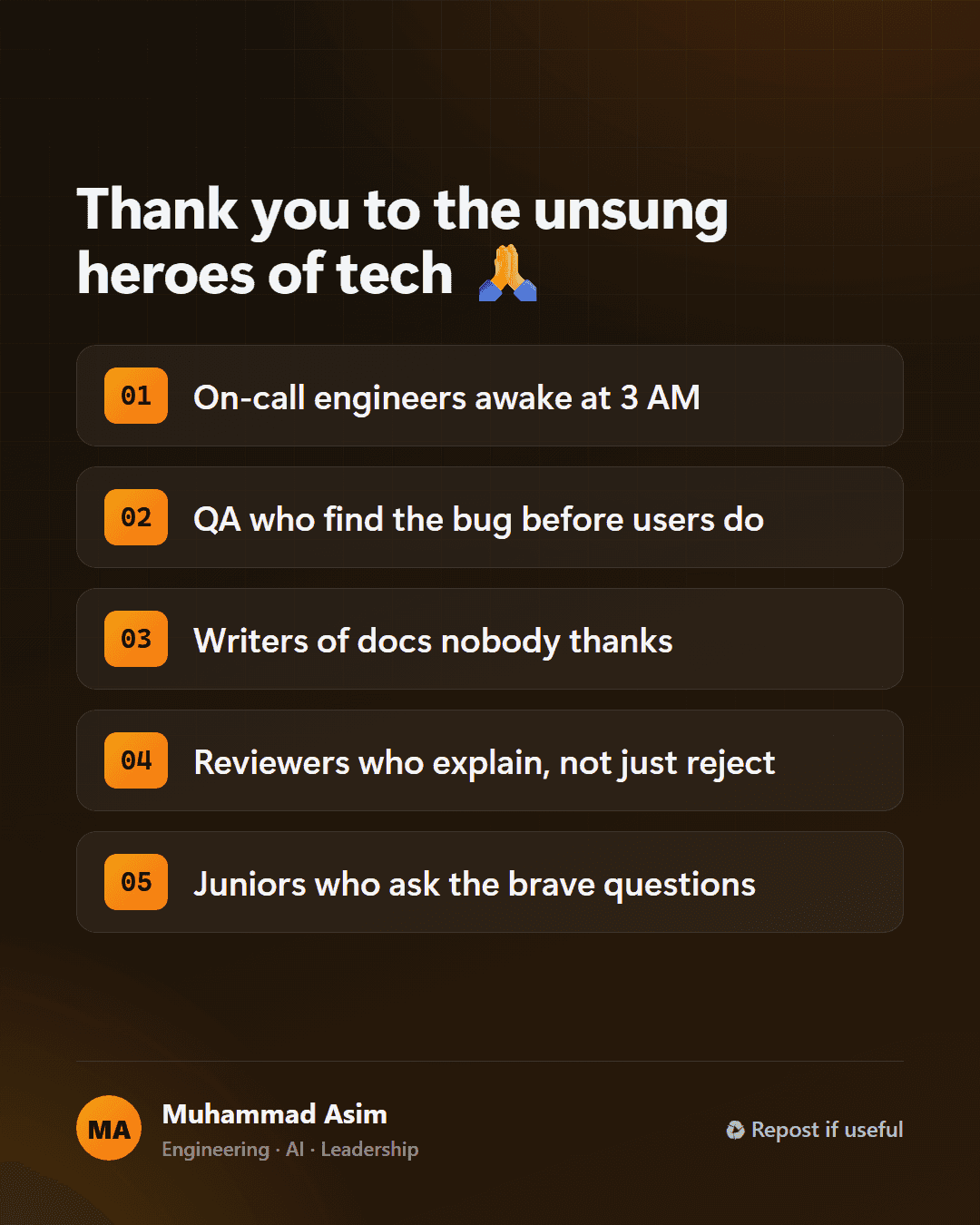
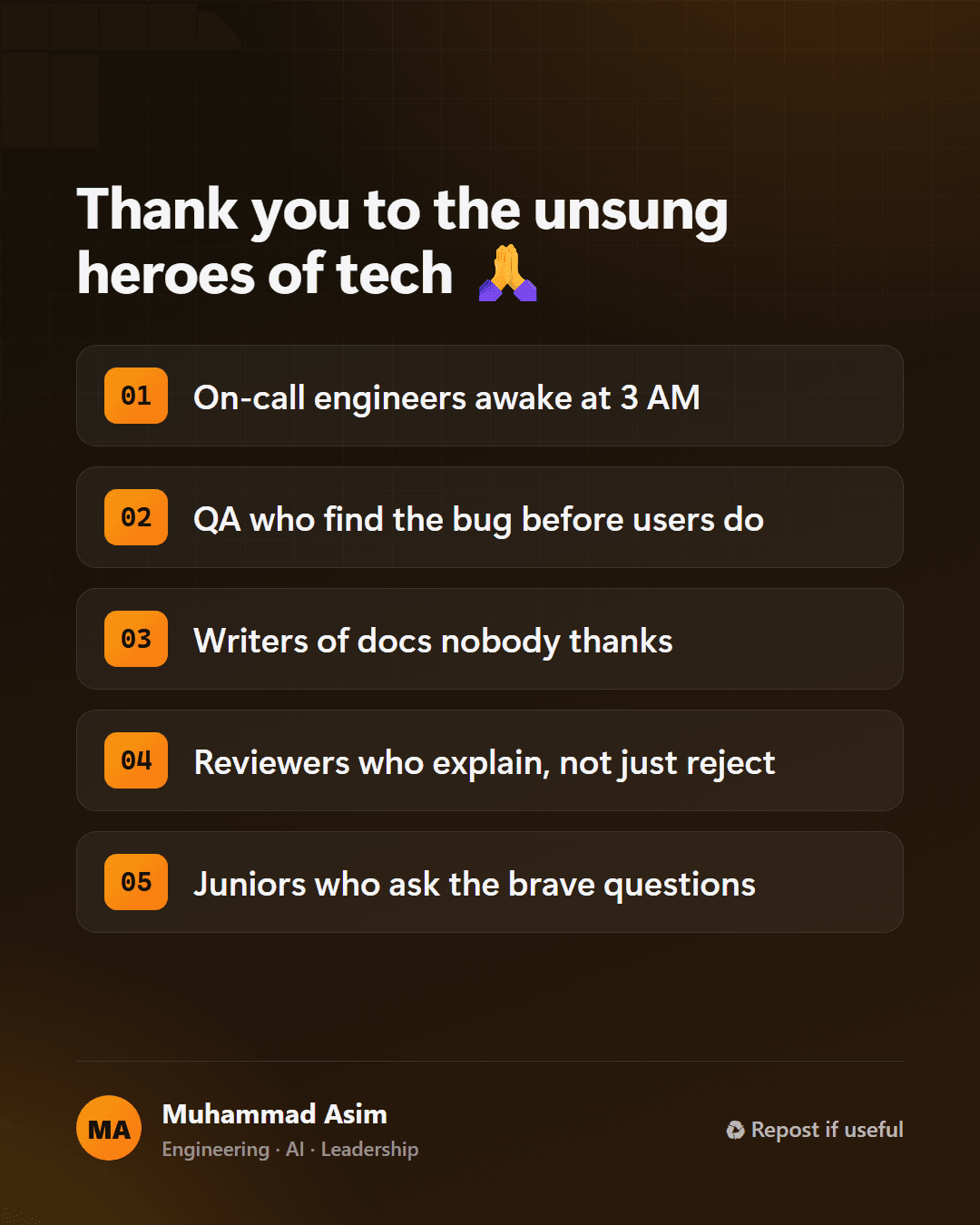
It is Thanksgiving in the US, so let us thank the unsung heroes of software who keep things running, and look at how teams can make that invisible work visible.
How to Trust an AI-Generated Regex Before It Reaches Production
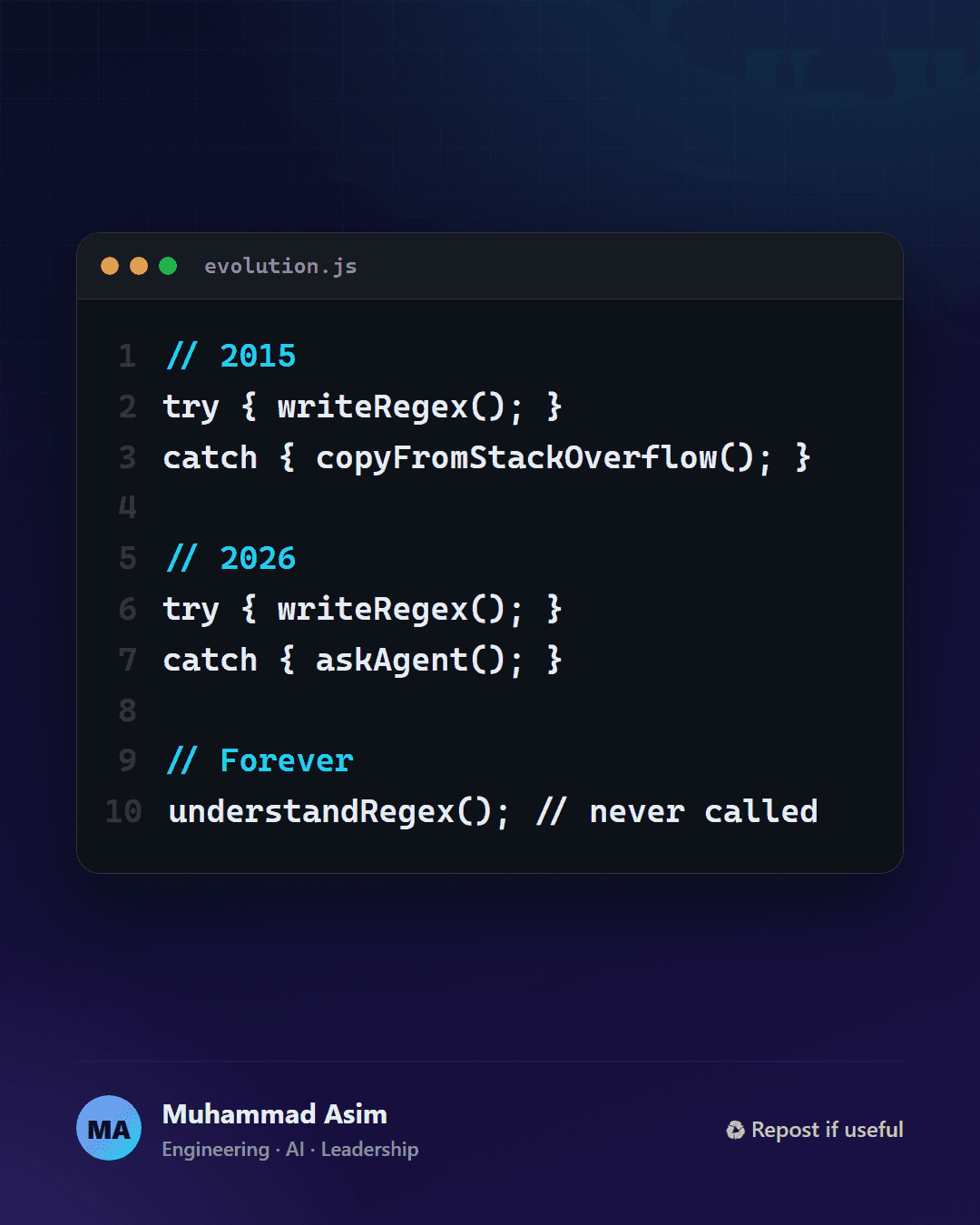
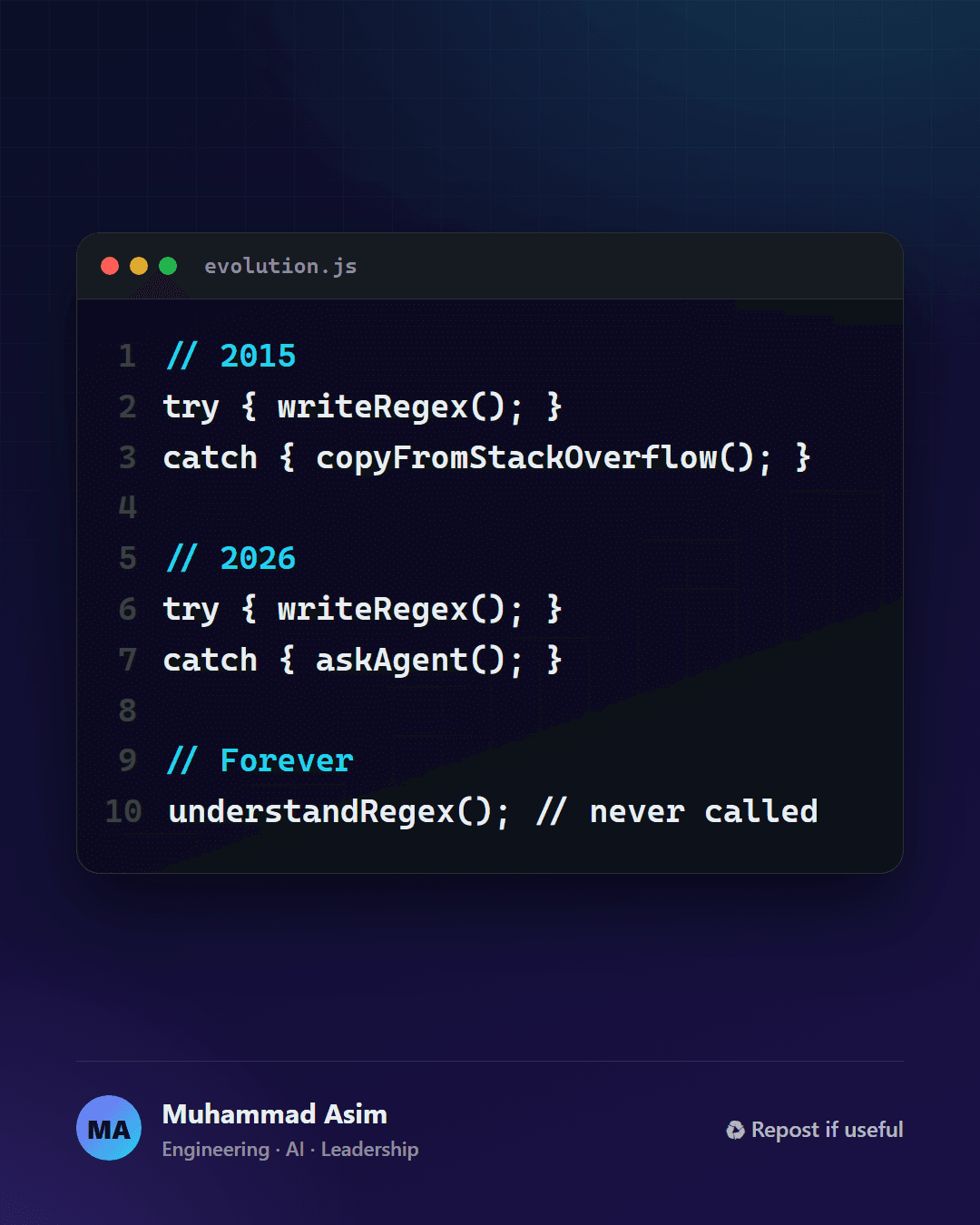
The evolution of writing regex: memory, Stack Overflow, now AI. The tools changed, the understanding did not. Here is how to trust an AI-generated regex in production.
Comments