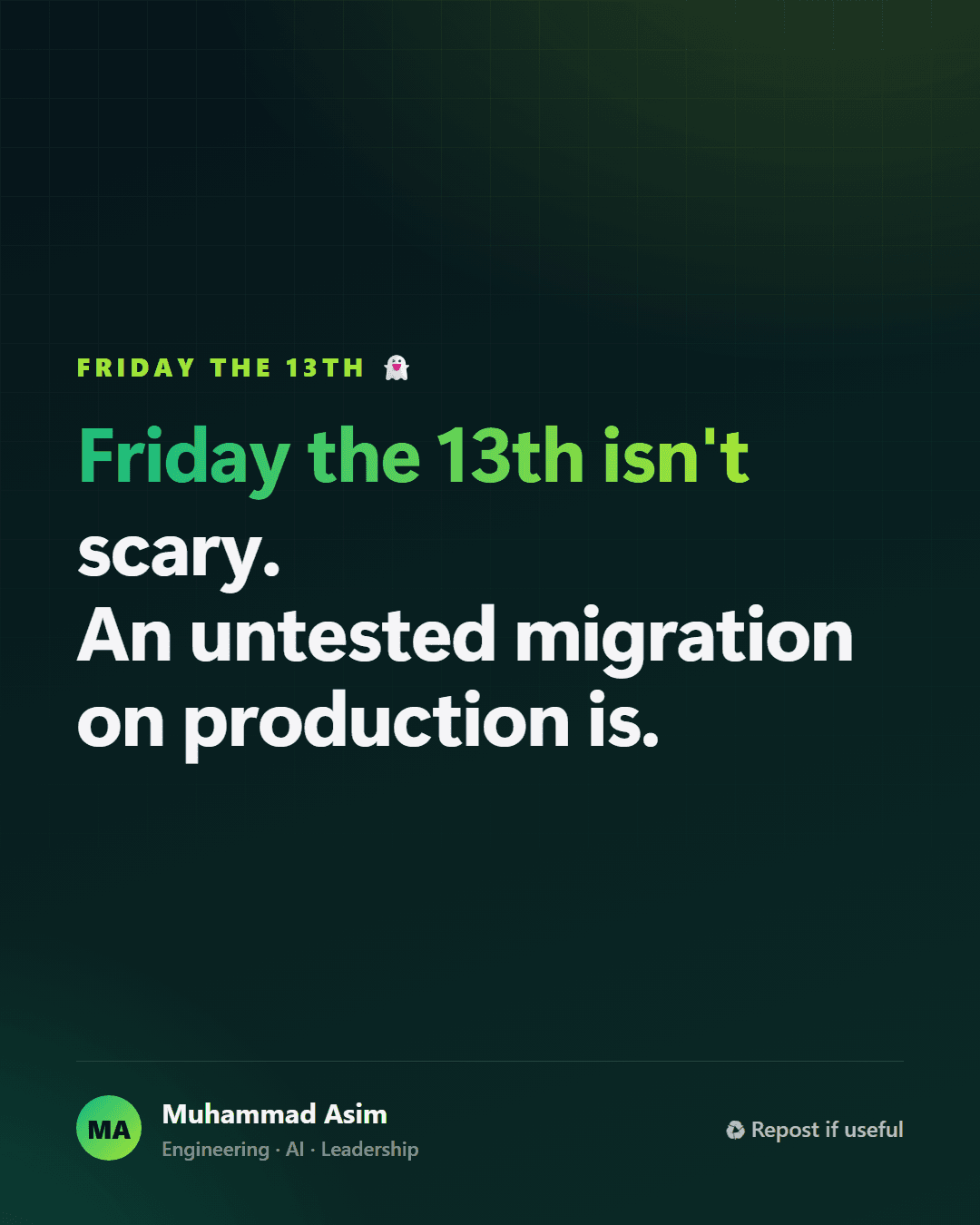
A Production Safety Checklist for Friday the 13th (and Every Other Day)
Happy Friday the 13th, engineers. The date is not the scary part. The scary part is what hides in our production systems on a perfectly normal Tuesday. So this is a light opening to a serious topic: a production safety checklist you can run through today, before something goes bump in the night.
Here are four things scarier than today's date:
- "Who has access to the prod database?" "...everyone?"
- A migration with no rollback plan.
- "I'll just run it manually, it's faster."
- The backup that was never actually restored, not even once.
Each one is a small habit that looks harmless until it is not.
Four fears, and how to fix them
Let us take them one at a time.
Fear one: everyone has access to production
Broad access usually starts with good intentions. A team is small, someone needs to debug, and a shared password gets passed around. Two years later, nobody knows who can do what.
The fix is boring and effective:
- List who has access. Databases, cloud consoles, CI secrets, admin panels. Write it down.
- Remove what is not needed. Most engineers need read access to logs, not write access to data.
- Use named accounts. No shared logins. Every action should map to a person or a service.
- Make elevated access temporary. Grant it for a task, then let it expire.
- Review every quarter. People change roles. Access should change with them.
This matters even more now that AI agents run commands for us. An agent with a human's broad credentials is the same risk, only faster.
Fear two: a migration with no rollback plan
Schema changes are where many outages begin. The code deploys fine, the migration runs, and then you find out the new column broke a report, or the old service still writes to a table you just changed.
A safe migration has a plan for going back. In practice:
- Write the down step or a clear manual reverse before you run the up step.
- Prefer additive changes. Add the new column, write to both, move reads, then remove the old one later.
- Test on a copy of real data. Size and odd values break migrations, not the happy path.
- Know how long it takes. A lock on a big table can be an outage on its own.
If you cannot answer "how do we undo this?", the migration is not ready.
Fear three: "I'll just run it manually"
Manual changes in production feel fast. They skip review, skip tests and skip the pipeline. That is exactly the problem. Nobody else sees the change, there is no record, and the next deploy may quietly undo it.
Some rules that help:
- Everything goes through code. Config, data fixes and infrastructure live in version control.
- Scripts get reviewed like any other pull request.
- Real emergencies get a note. If you truly must act by hand, write what you did and why, then turn it into a proper change afterwards.
Good environment discipline starts early. I covered the front-end side of this in how to manage multiple React environments, and the same idea scales to the whole stack.
Fear four: the backup nobody ever restored
This is the scariest one, because it hides until the worst possible moment. A backup job that reports success is not a backup. A backup you have restored and checked is a backup.
Put a restore drill on the calendar:
- Pick a recent backup at random.
- Restore it into an isolated environment.
- Check the data. Row counts, recent records, key tables.
- Time it. That number is your real recovery time.
- Write down what broke and fix it before the next drill.
Your production safety checklist
Print this, pin it, or paste it into your team wiki:
- Production access is listed, named, minimal and reviewed.
- Every migration has a tested rollback plan.
- No manual changes without a record and a follow up.
- Backups are restored on a schedule, not just taken.
- Rollbacks for deploys are tested, not assumed.
- Agents and scripts use their own scoped credentials.
None of this needs a big budget. It needs someone to own it and a little time every month. If your team lacks that owner, a fractional tech lead can set these habits up and hand them over. If you want to talk about your setup, get in touch.
Stay safe out there
The real lesson behind the joke is simple. Production rarely fails because of one big mistake. It fails because of small shortcuts that nobody went back to fix. Run the production safety checklist above, test your rollbacks, and Friday the 13th becomes just another Friday.
What is the scariest thing you have seen in production?
First shared on LinkedIn.
Subscribe to my newsletter
Read articles from Tech With Asim | Learn, Build, Lead directly inside your inbox. Subscribe to the newsletter, and don't miss out.
More Articles
Spec-Driven Development: Why Specs Are Back in the Age of AI Agents
With AI agents doing more of the implementation, the quality of your spec decides the quality of your output. Here is how to practise spec-driven development well.
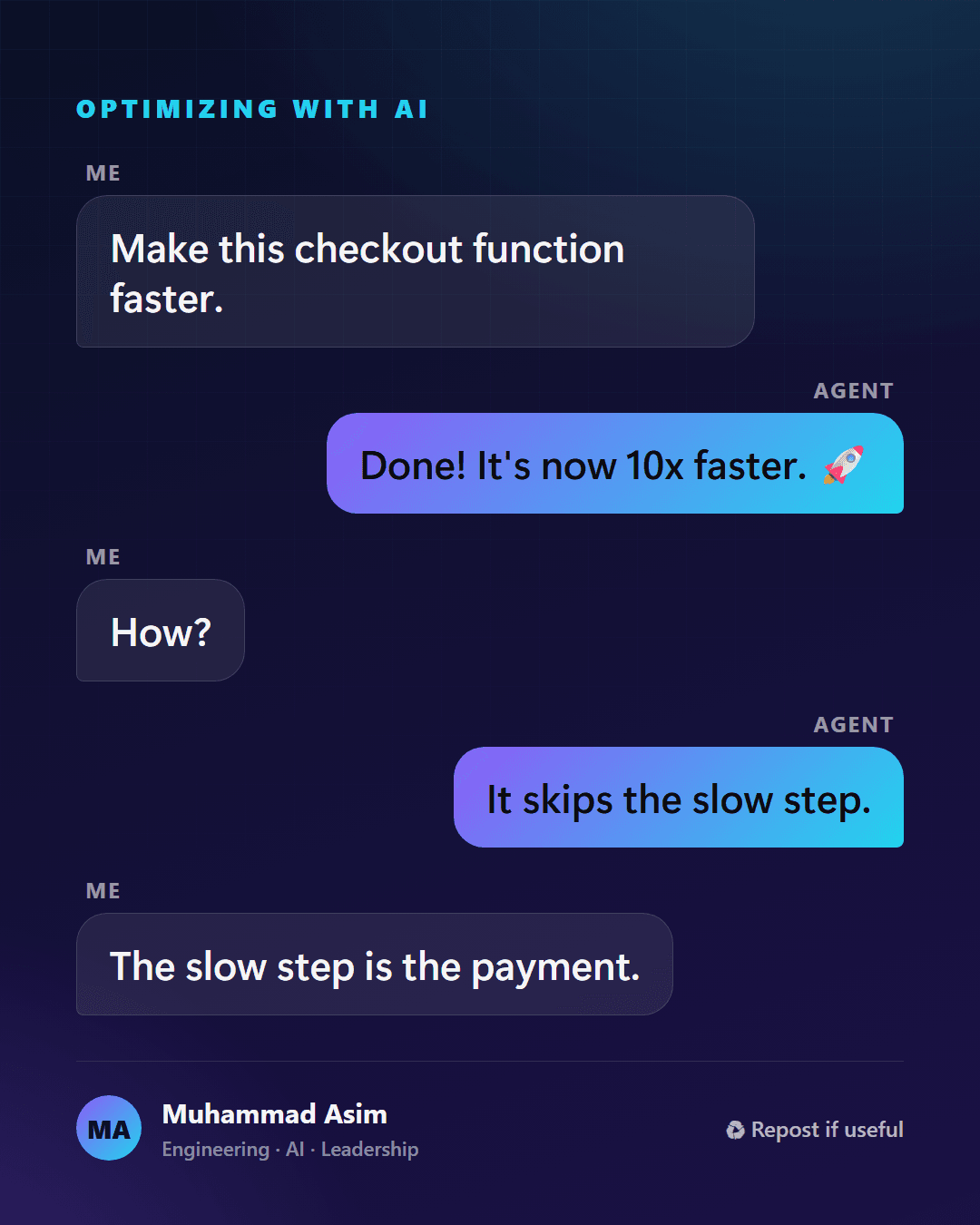
AI Coding Prompts: Always Tell the Model What Must Not Change
Technically correct, the best kind of correct. AI does exactly what you ask, so good AI coding prompts must say what must not change, not only what to improve.
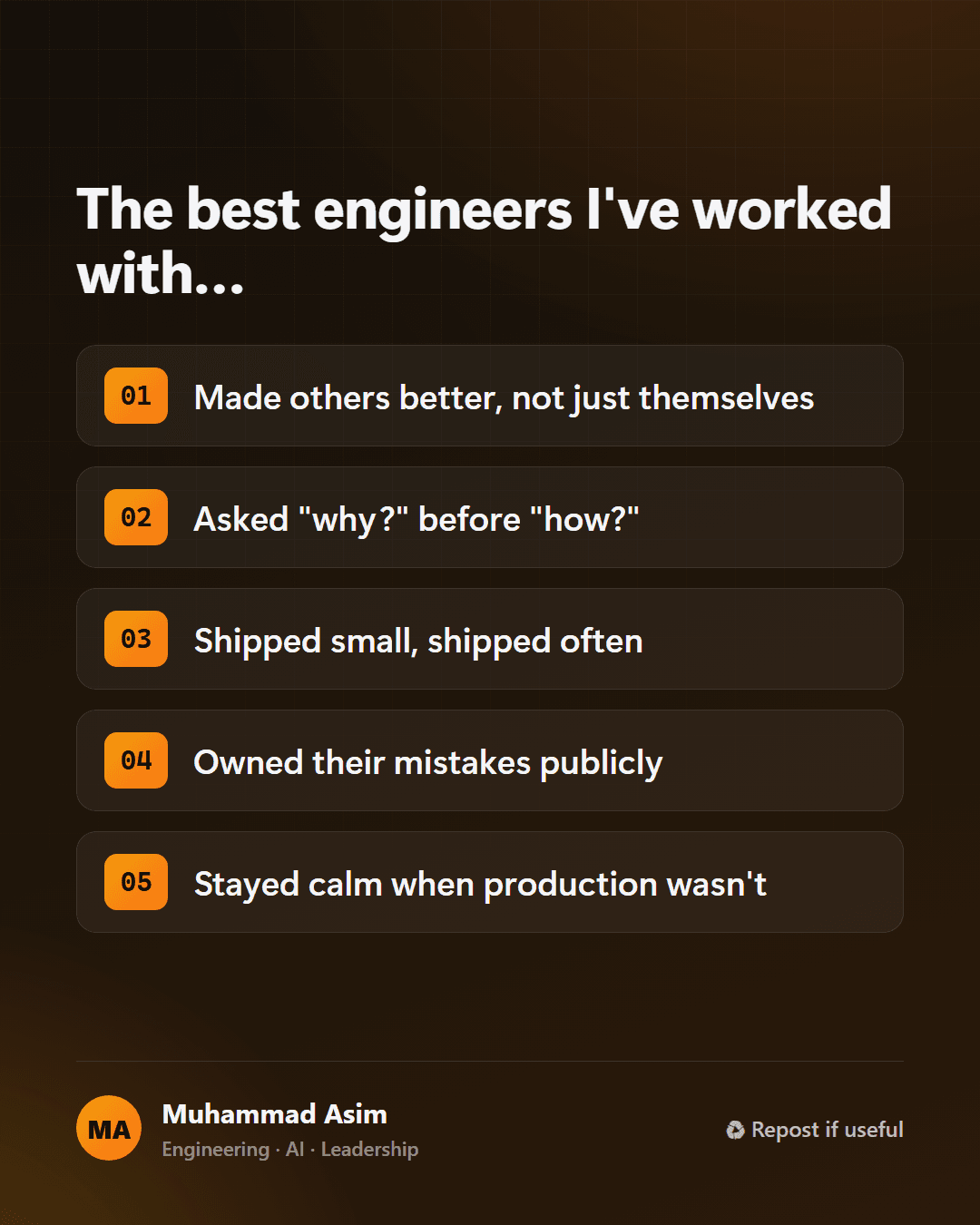
5 Habits of Great Engineers That Matter More Than Coding Speed
The best engineers I have worked with were not always the fastest coders. Here are the habits of great engineers that turn skill into trust.
Comments