A 10-Minute Meeting Audit to Win Back Engineering Focus Time
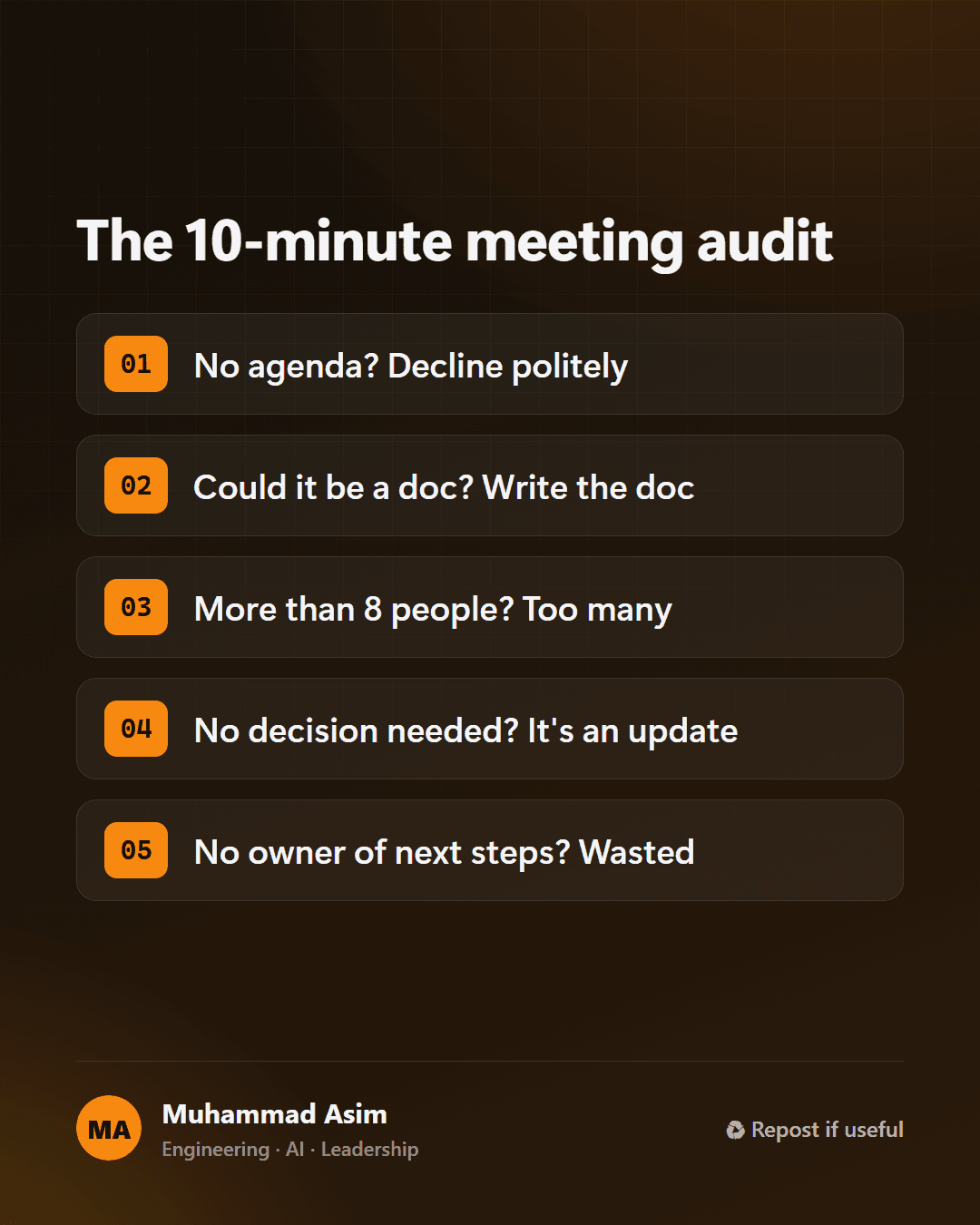
Try this today: spend ten minutes on a meeting audit. Open your calendar, look at every recurring meeting, and ask a few hard questions about each one. Most people find at least one or two meetings they can drop, shrink or replace with something written.
Engineers need long blocks of focus. Every unneeded meeting is a tax on your product.
Why meetings cost engineers more than they seem
A one-hour meeting does not cost one hour. Deep technical work needs time to get into. You load the problem into your head, the code, the data, the edge cases. A meeting in the middle of the afternoon breaks that. You lose the time before it, because there is no point starting something hard, and the time after it, while you rebuild context.
Two half-hour meetings spread across a morning can wipe out the whole morning for real engineering work. That is why the shape of your calendar matters as much as the number of meetings.
The meeting audit: five questions
Go through each recurring meeting and ask these questions in order.
No agenda? Decline politely.
A meeting without an agenda has no clear purpose. Reply kindly and ask for one: "Happy to join. Could you share what we need to decide or discuss?" Often the agenda appears and the meeting gets better. Sometimes the meeting quietly disappears.
Could this be a doc? Write the doc.
Many meetings exist to share information: status, plans, design ideas. A short written document does this better. People can read it when they have time, comment in place and come back to it later. If a discussion is still needed after the doc, the meeting will be shorter and more focused.
More than 8 people? Too many to decide anything.
Large meetings are good for announcements and bad for decisions. With many people in the room, most stay quiet and a few talk. If the goal is a decision, invite only the people who need to make it or give key input. Share the outcome with everyone else.
No decision needed? It's an update. Send it async.
If nobody needs to decide anything, the meeting is just an update. Updates work well in writing: a short message in a channel, a weekly summary, a recorded video. People read them at a time that suits them, and focus time stays intact.
No owner for next steps? It's wasted time.
A meeting that ends without clear actions and owners will often need to happen again. Before the meeting ends, someone should say who will do what, by when. If that never happens in a recurring meeting, raise it, or step out.
What to do with the results
After the meeting audit, you will usually have three groups:
- Keep: meetings with a clear purpose, the right people and real decisions.
- Change: meetings that need an agenda, fewer people, less time or a lower frequency.
- Replace or drop: meetings that should become a doc, an async update, or nothing.
Act on the second and third groups this week. Talk to the organiser first. Most organisers are happy to improve a meeting, since they often feel the same pain.
Protecting focus time as a team
Individual audits help, but team habits help more. A few ideas that work well for engineering teams:
- Meeting-free blocks. Agree on two or three half days a week with no internal meetings.
- Cluster meetings. Put them next to each other, ideally at the start or end of the day.
- Default to 25 or 50 minutes. Leave a gap between calls.
- Write things down. Decisions, notes and actions go in a shared place, so people who were not there can catch up.
For remote teams this is even more important, because the calendar easily takes over the whole day. I shared some related ideas in my post on work-life balance in remote work.
If you lead a team, make the meeting audit a regular habit, perhaps once a quarter. It is one of the cheapest ways to improve delivery. It is also something I look at early when I work with teams as a fractional tech lead. If you want an outside view on your team's process, get in touch.
Your 10-minute checklist
- Open your calendar for the next two weeks.
- For every recurring meeting, ask the five questions.
- Decline, shorten or replace at least one.
- Block two long focus sessions for yourself.
How many hours of meetings do you have this week, and how many survived your audit?
First shared on LinkedIn.
Subscribe to my newsletter
Read articles from Tech With Asim | Learn, Build, Lead directly inside your inbox. Subscribe to the newsletter, and don't miss out.
More Articles
Spec-Driven Development: Why Specs Are Back in the Age of AI Agents
With AI agents doing more of the implementation, the quality of your spec decides the quality of your output. Here is how to practise spec-driven development well.
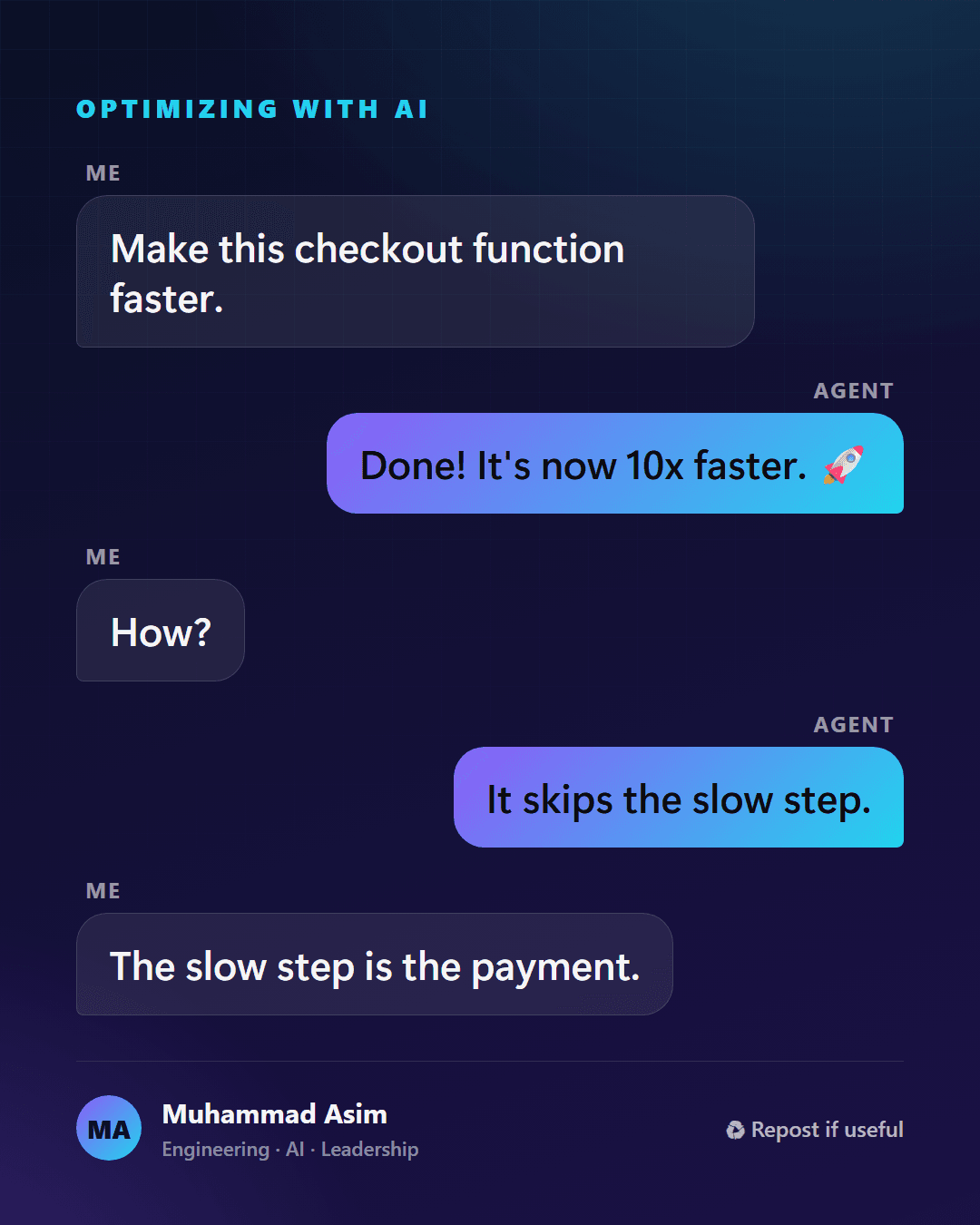
AI Coding Prompts: Always Tell the Model What Must Not Change
Technically correct, the best kind of correct. AI does exactly what you ask, so good AI coding prompts must say what must not change, not only what to improve.
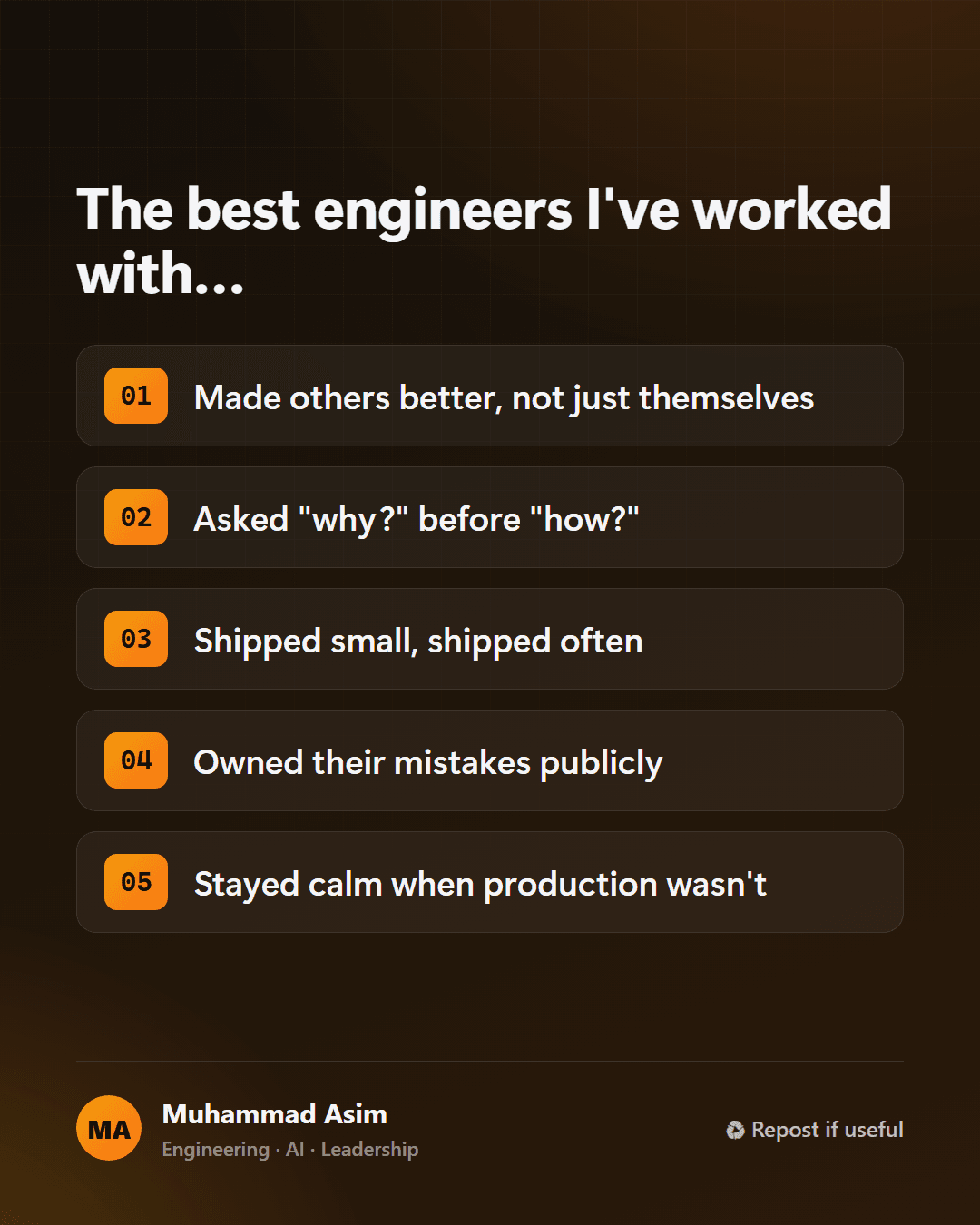
5 Habits of Great Engineers That Matter More Than Coding Speed
The best engineers I have worked with were not always the fastest coders. Here are the habits of great engineers that turn skill into trust.
Comments