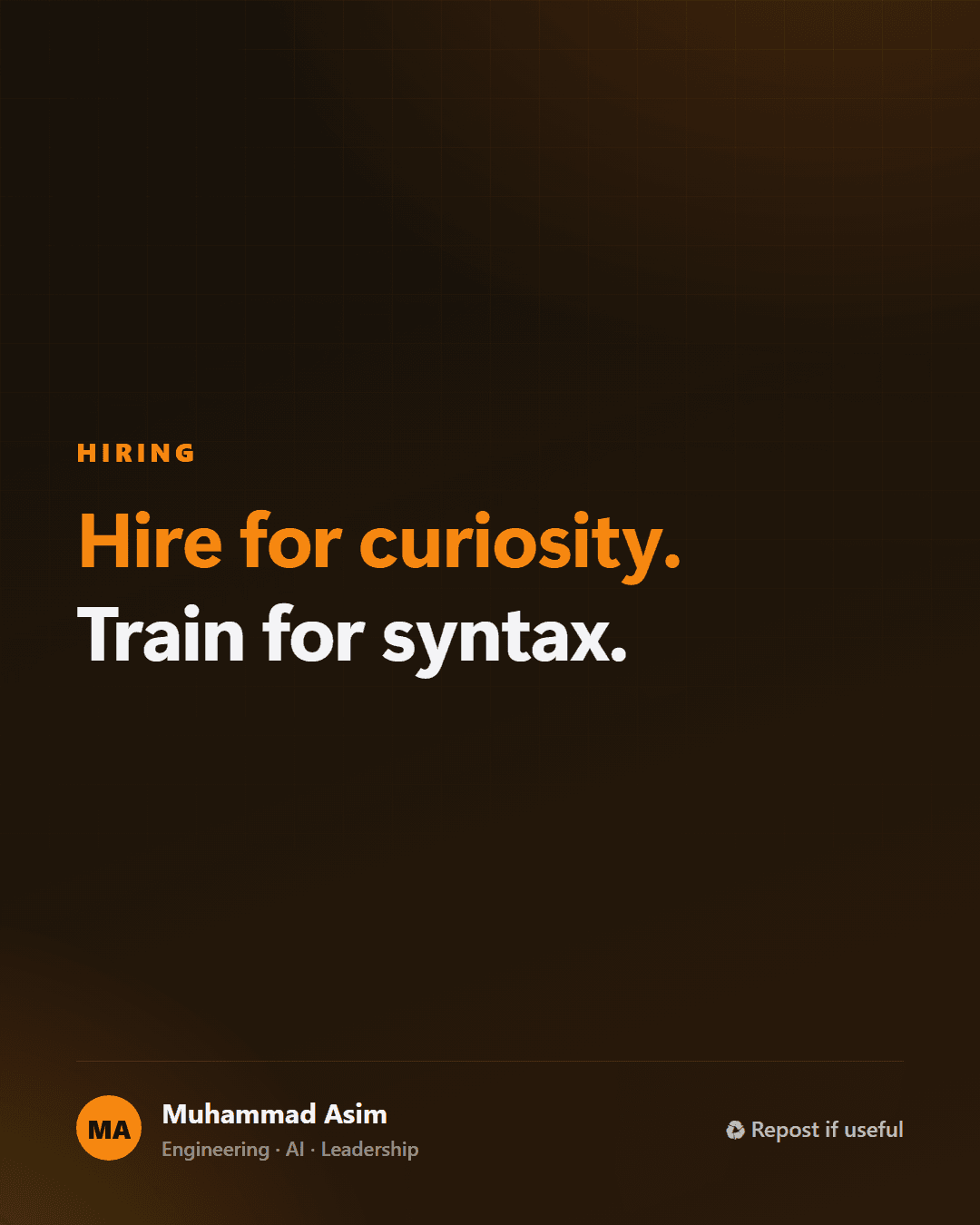
Hire for Curiosity, Train for Syntax: What I Look for in Engineers
Hire for curiosity. Train for syntax. That is the simplest hiring rule I know, and it matters more every year. Frameworks change every few years. Languages rise and fall. In 2026 an AI can write the boilerplate in seconds. So when you hire for curiosity, you are betting on the one trait that keeps paying off after the tech stack changes.
Every great engineer I've worked with had this in common: they were curious first and skilled second.
Why syntax is the easy part
Specific skills still matter. Nobody wants to teach a senior engineer what a loop is. But the exact framework or library on a CV has a short shelf life. The tools I used early in my career look very different from the ones I use now, and the ones I use now will change again.
AI speeds this up. When an assistant can produce working code in a new language in minutes, knowing syntax by heart is less of an edge. What matters is whether someone can tell if that code is right, understand why it works and learn the next thing quickly.
That is curiosity doing its job.
What curiosity looks like in practice
Curiosity is not a buzzword on a job post. It shows up in small, specific behaviours.
Asking "why does this work?"
Many people stop when the code works. Curious engineers keep going until they understand why. That habit is what turns a quick fix into real knowledge, and it is exactly what you need when reviewing AI output.
Reading the docs when nobody's watching
Nobody asks them to. They do it because they want to know how the tool really behaves, including the parts the tutorial skipped. This is often where they find the setting, the limit or the edge case that saves the team a week later.
Getting excited about a hard bug instead of avoiding it
Some people see a hard bug as a threat. Curious people see a puzzle. They dig in, form theories and enjoy the moment it finally makes sense. Teams need people who run toward hard problems.
How to spot curiosity in an interview
Curiosity is hard to fake for long, but you have to give it room to show. A few approaches that help:
- Ask about something they learned recently, just because they wanted to. Then ask follow up questions. Depth shows quickly.
- Ask about a bug they are proud of solving. Listen for how they investigated, not just the fix.
- Give a problem with no single right answer. Watch whether they ask clarifying questions before jumping in.
- Notice the questions they ask you. Curious candidates ask about the system, the team and the hard problems.
- Pair on real code. See how they react when something unexpected happens.
On the other side, be careful with signals that look like curiosity but are not. Listing many technologies on a CV is not the same as understanding any of them deeply.
Keeping curiosity alive in your team
Hiring curious people is only half the job. Teams can kill curiosity without meaning to:
- No time to learn. If every hour goes to tickets, nobody explores. Protect some time.
- Punishing questions. If "why?" gets treated as a challenge, people stop asking.
- Only rewarding speed. If shipping fast is the only thing praised, deep understanding looks like a waste.
Instead, ask "why" in code reviews, share interesting bugs in team meetings and let people pick up unfamiliar work now and then. Curiosity grows where it is noticed.
If you are early in your career and want to build this habit, my guide to jump-starting a front-end development career has practical ideas. And if you are building a team, you can learn how I work on my about page or look at how I approach helping companies hire a full stack developer.
The takeaway
Skills can be taught. Curiosity is much harder to teach. When you hire for curiosity and train for syntax, you build a team that keeps up no matter how the tools change, including the AI tools that are changing everything right now.
What trait do you look for that is not on the job description? If you want help shaping how your team hires and grows, get in touch.
First shared on LinkedIn.
Subscribe to my newsletter
Read articles from Tech With Asim | Learn, Build, Lead directly inside your inbox. Subscribe to the newsletter, and don't miss out.
More Articles
Spec-Driven Development: Why Specs Are Back in the Age of AI Agents
With AI agents doing more of the implementation, the quality of your spec decides the quality of your output. Here is how to practise spec-driven development well.
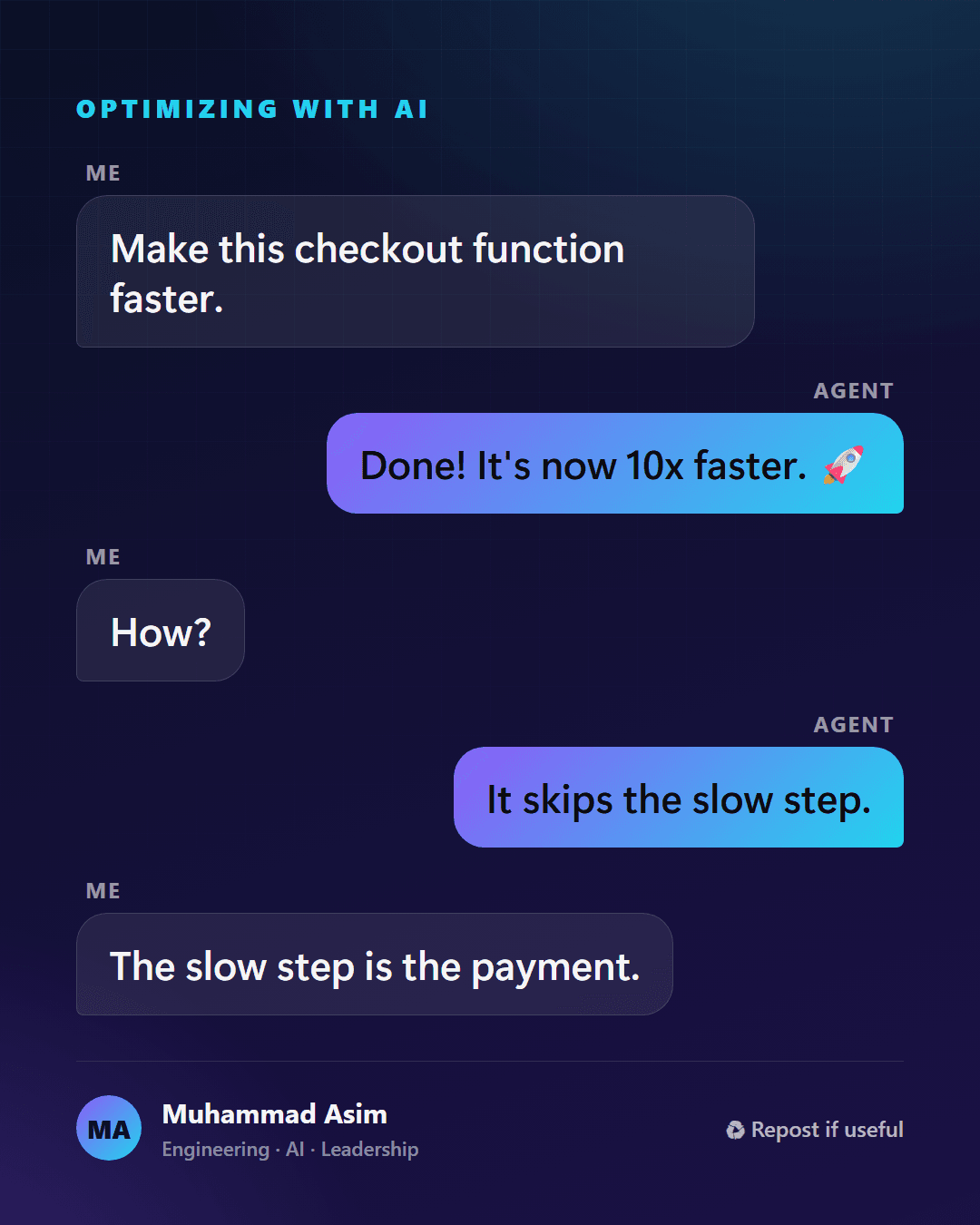
AI Coding Prompts: Always Tell the Model What Must Not Change
Technically correct, the best kind of correct. AI does exactly what you ask, so good AI coding prompts must say what must not change, not only what to improve.
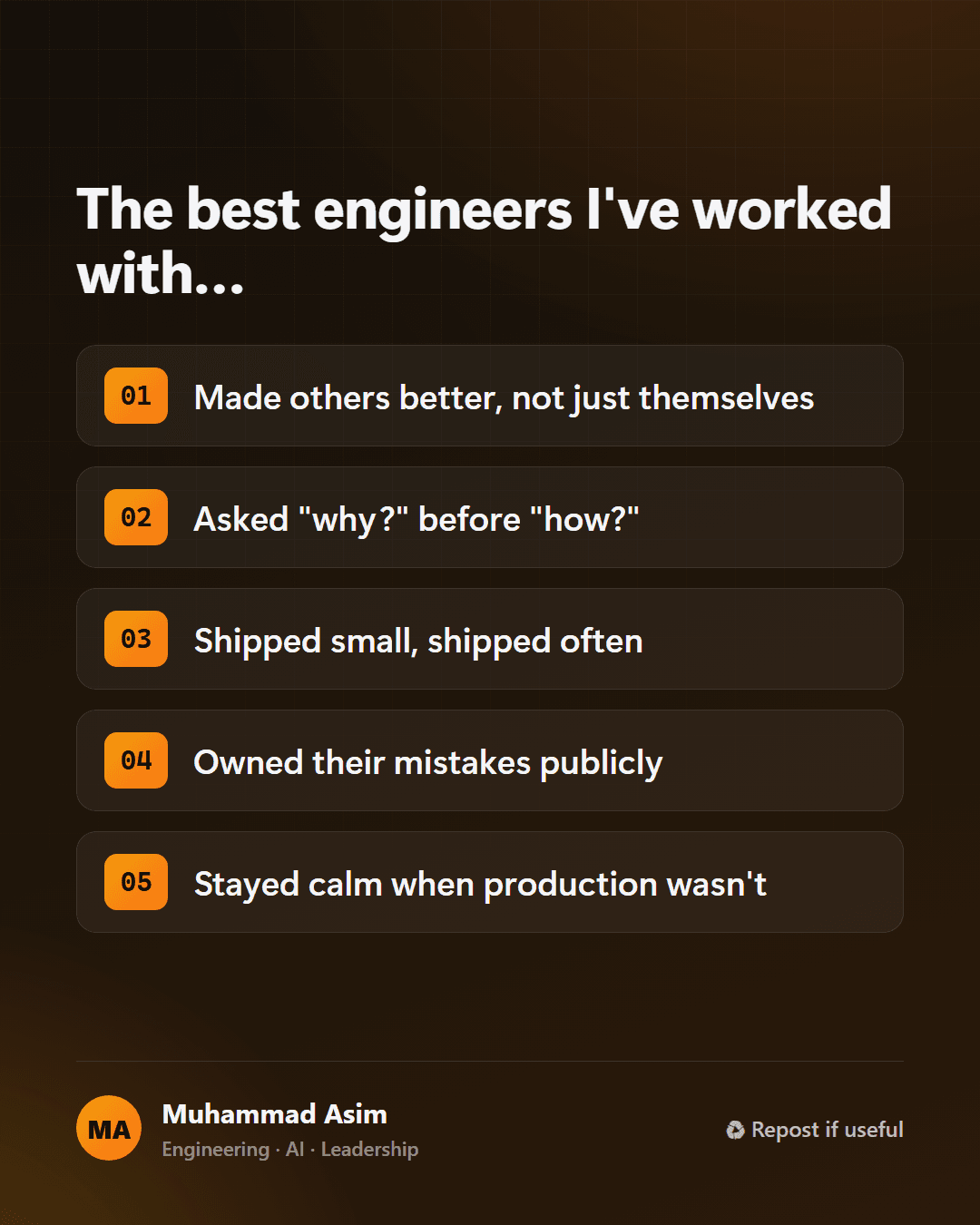
5 Habits of Great Engineers That Matter More Than Coding Speed
The best engineers I have worked with were not always the fastest coders. Here are the habits of great engineers that turn skill into trust.
Comments