How to Evaluate AI Coding Agents for Your Team: A 5-Point Checklist
Android Studio now lets developers install and switch between more than 40 coding agents. Choice is the new normal. That changes the question teams should ask. The real skill is not picking "the best AI." It is learning how to evaluate AI coding agents for fit: fit with your codebase, your workflow and your budget.
A leaderboard can tell you which model solves puzzles well. It cannot tell you which agent will respect your folder structure, run your test suite and admit when it does not know something. Those are the things that decide whether an agent helps your team or creates extra review work.
Why benchmarks are not enough
Public benchmarks are useful for a first filter. They show raw capability on standard tasks. But your product is not a standard task. It has naming conventions, old modules nobody wants to touch, internal libraries and business rules that live in people's heads.
An agent that scores well on a benchmark can still:
- Ignore your patterns and invent its own.
- Write code that compiles but breaks a rule only your team knows.
- Produce huge diffs that take longer to review than to write by hand.
Benchmarks don't ship your product. Your team does, with whatever tool you give them. So the evaluation has to happen where the work happens.
My checklist to evaluate AI coding agents
These are the five questions I use. They are simple on purpose, so any team can answer them after a short trial.
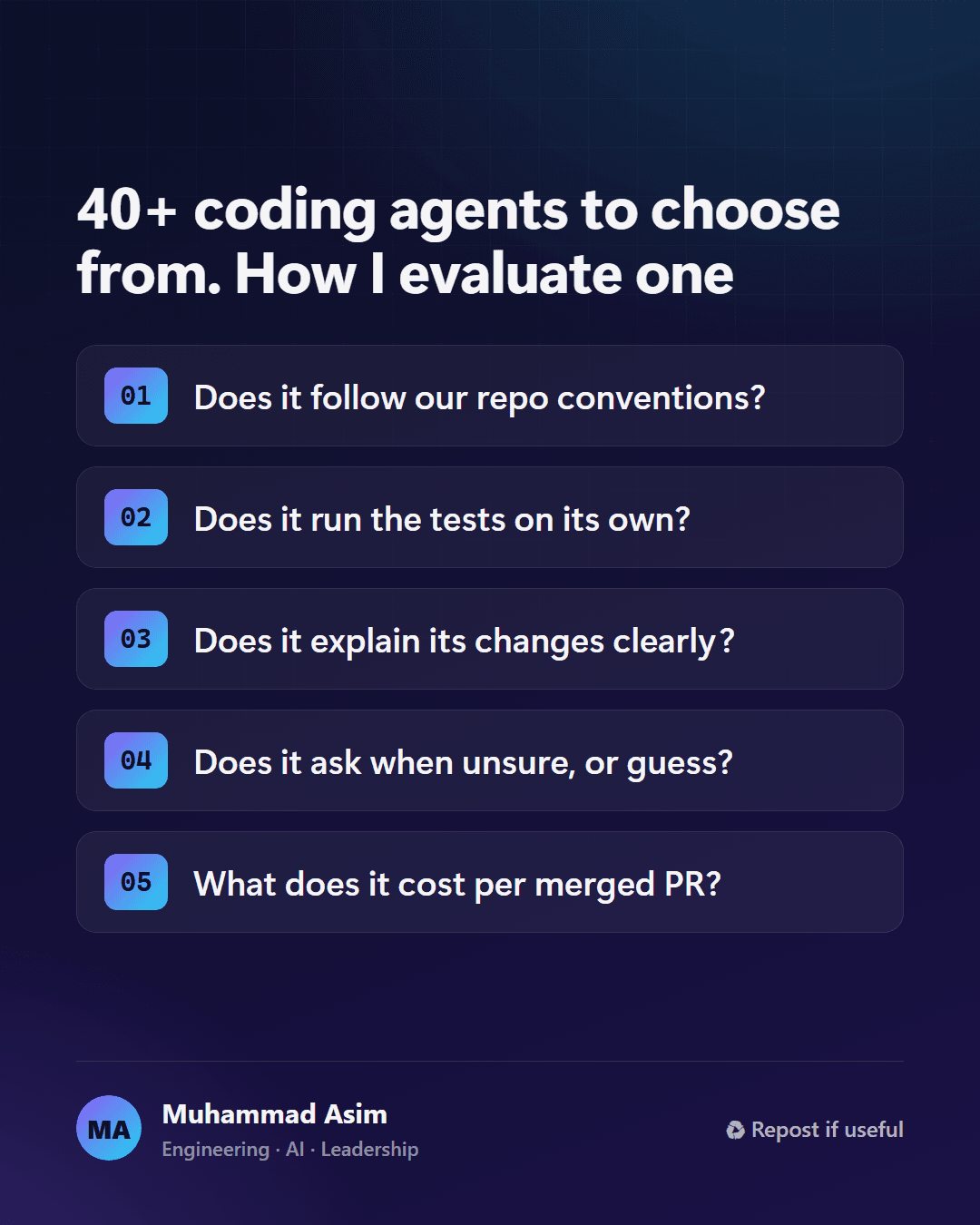
1. Does it follow our repo conventions?
Look at the code it produces next to the code your team writes. Same naming? Same file layout? Same error handling style? Does it use your existing helpers, or does it write new ones that do the same thing? Good agents read the surrounding code and copy its style. Weak ones bring their own habits.
2. Does it run the tests on its own?
An agent that writes code and stops is half done. The agents worth using run the existing tests, read the failures and fix them before saying "finished." Even better, they add tests for new behaviour. If you have to remind it every time, that is a cost.
3. Does it explain its changes clearly?
You will review every change, so the explanation matters. A good summary says what changed, why, and what it did not touch. A vague "updated the component" forces you to read every line with no context.
4. Does it ask when unsure, or confidently guess?
This is the most important question for me. A confident wrong answer is far more expensive than a clear question. Give it a task with a real gap, like a missing requirement, and see what happens. Does it stop and ask, or does it fill the gap with a guess and move on?
5. What does it cost per merged PR, not per token?
Token prices are easy to compare and mostly misleading. A cheap agent that needs three attempts and a long review is not cheap. Measure the cost of getting one change merged: tool cost plus the engineer time spent prompting, fixing and reviewing.
Run a two-week trial on real tickets
Here is a simple way to run the evaluation without turning it into a big project.
- Pick two or three agents. More than that and the trial gets noisy.
- Use real tickets from your backlog. Mix small bugs, a medium feature and one task in an older part of the code.
- Give each agent the same context. Same repo instructions, same access, same task description.
- Score each task against the five questions above. A simple 1 to 5 score per question is enough.
- Track time and cost from first prompt to merged PR.
- Ask the engineers. Their experience matters as much as the numbers. A tool people dislike will not get used.
Two weeks is long enough to see patterns and short enough that nobody gets attached.
If you are comparing editor assistants rather than full agents, my older comparison of GitHub Copilot, Tabnine and IntelliCode uses a similar fit-first approach.
Make the agent fit better over time
Evaluation does not end when you pick a tool. Most agents work better when you give them good project context: a short instructions file that explains your conventions, how to run tests, and what must never change. Investing in that context often matters more than the choice of agent itself. I describe how I set this up in my AI native engineering workflow.
Revisit the decision every few months. The market moves fast, and the agent that fits best today may not be the one that fits best next quarter. Keep your trial process simple so you can repeat it.
Key takeaways
- Choice is now normal, so evaluation is a core team skill.
- Test fit on your code, not on benchmarks.
- Prefer agents that follow conventions, run tests, explain clearly and ask when unsure.
- Measure cost per merged PR, not per token.
- Run short trials on real tickets and repeat them.
If you want help running this kind of trial or setting up agents for your team, I offer Claude Code consulting, or you can simply get in touch.
Which agents is your team using, and how did you choose them?
First shared on LinkedIn.
Subscribe to my newsletter
Read articles from Tech With Asim | Learn, Build, Lead directly inside your inbox. Subscribe to the newsletter, and don't miss out.
More Articles
Spec-Driven Development: Why Specs Are Back in the Age of AI Agents
With AI agents doing more of the implementation, the quality of your spec decides the quality of your output. Here is how to practise spec-driven development well.
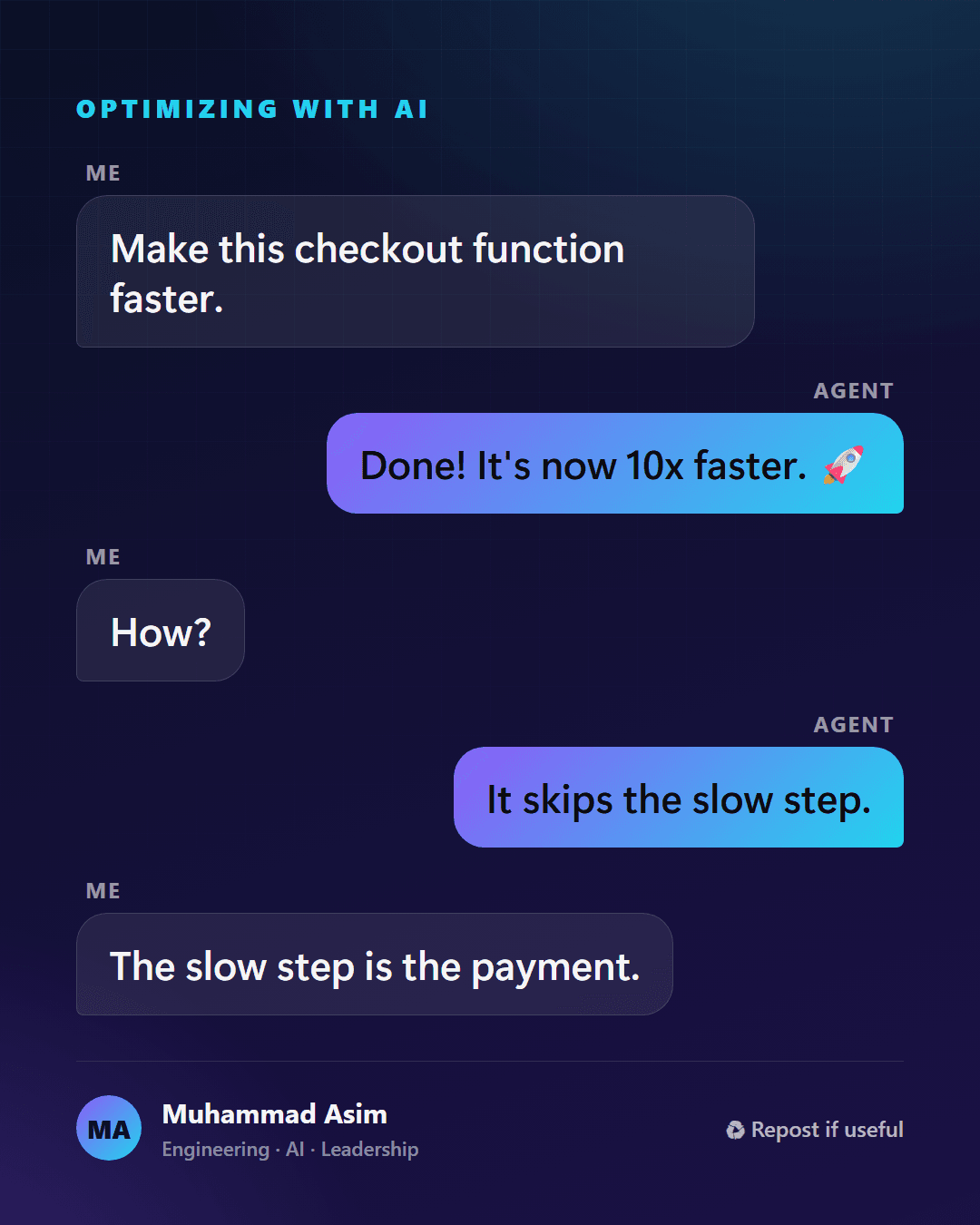
AI Coding Prompts: Always Tell the Model What Must Not Change
Technically correct, the best kind of correct. AI does exactly what you ask, so good AI coding prompts must say what must not change, not only what to improve.
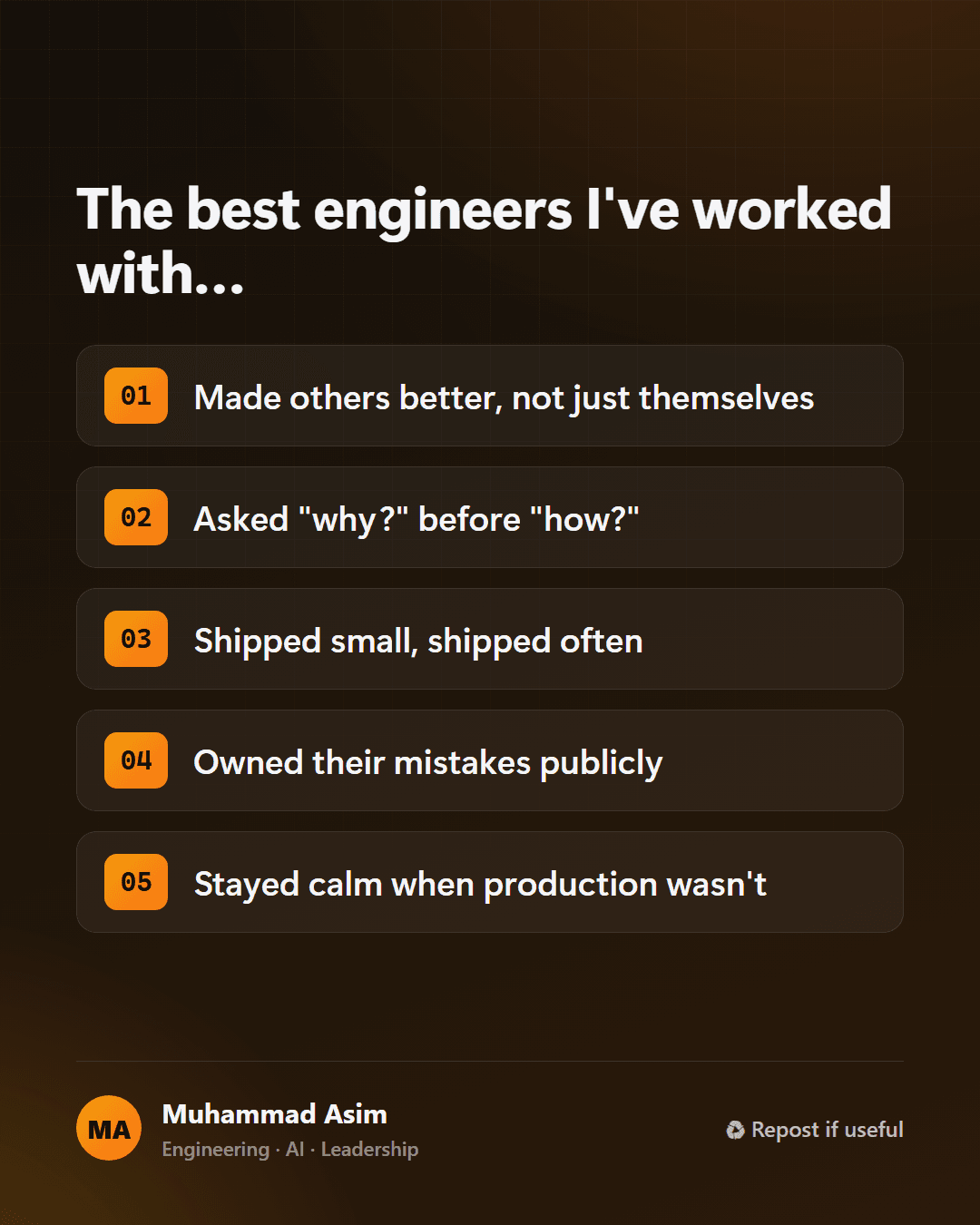
5 Habits of Great Engineers That Matter More Than Coding Speed
The best engineers I have worked with were not always the fastest coders. Here are the habits of great engineers that turn skill into trust.
Comments