Engineering Team Health: The Signals That Matter More Than Velocity
Your team's velocity is not your team's health. A team can ship fast for months and burn out in a week. That is why I treat engineering team health as its own thing to watch, separate from story points, burndown charts and sprint reports.
Velocity tells you how much work moved last sprint. It does not tell you whether people are tired, afraid, or quietly looking for another job. By the time those problems show up in the numbers, they are already expensive.
Metrics tell you what happened. People tell you what is about to happen.
Why velocity misleads
Velocity is useful for planning. It is a poor proxy for health, for a few reasons:
- It can be inflated. Teams under pressure re-estimate stories upward, and the chart looks better while nothing improves.
- It hides heroics. One person working late every night can keep the line flat for a long time.
- It lags. Burnout builds for weeks before output drops, and then it drops all at once.
- It ignores knowledge risk. A fast team where only one person understands the core system is fragile.
So I keep velocity on the dashboard, but I do not let it answer the question "is this team okay?"
Five signals I watch more closely than story points
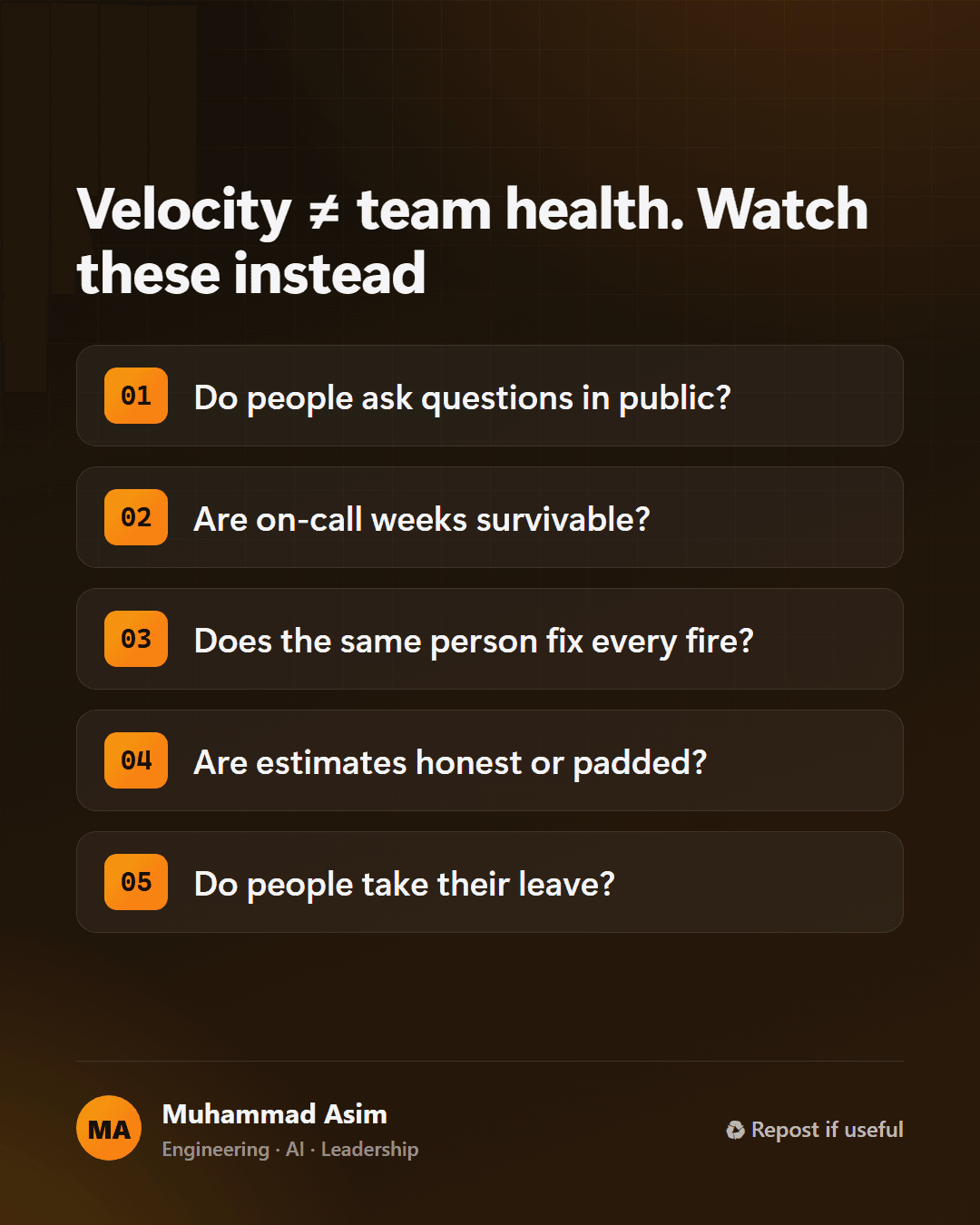
1. Do people ask "dumb" questions in public channels?
When people ask basic questions openly, it means they feel safe not knowing something. When questions move to private messages, or stop altogether, people are worried about how they look. Psychological safety shows up first in small questions.
2. Are on-call weeks survivable?
If on-call means broken sleep and a ruined weekend every time, people will dread it and eventually leave. Look at how many pages happen, how many are at night, and how many are real. Noisy alerts and fragile systems are a health problem, not just a technical one.
3. Does the same person fix every fire?
Every team has a hero. Heroes are great until they go on leave, get sick, or burn out. If one name appears on every incident, that is a single point of failure for both the system and the person. Spread the knowledge on purpose.
4. Are estimates honest, or padded out of fear?
Honest estimates include uncertainty. Fearful estimates are padded because people expect to be blamed for being late. If estimates keep growing while the work stays similar, ask why. Often the answer is trust, not skill.
5. Do people actually take their leave?
Unused leave is a warning sign. It can mean people feel they cannot step away, or that the work will collapse without them. Leaders should take their own leave visibly and make it normal for everyone else.
What to do when the signals slip
Noticing is the first step. Acting is the second. Some practical moves:
- Ask directly in one to ones. "How sustainable does your workload feel, from one to ten?" is a simple, useful question.
- Fix the noisiest alerts first. A quieter on-call rotation is one of the fastest morale wins.
- Pair the hero with others. Make knowledge sharing part of their goals, not an extra.
- Reward honest estimates. Thank people for raising risk early, even when the news is bad.
- Plan for leave. Make cover part of sprint planning so time off does not feel like abandoning the team.
Remote teams need extra care here, because many of these signals are harder to see on a video call. I wrote about the personal side of this in mastering work-life balance in remote work.
Engineering team health in the age of AI
AI tools can make velocity jump. That is good news, but it adds a new risk. When output goes up, expectations go up with it, and people can end up running faster just to stand still. Reviewers get flooded, and the pace becomes the new baseline.
Watch engineering team health more closely, not less, when you adopt AI. Faster delivery only matters if the team can sustain it.
A short checklist
- Basic questions happen in public channels.
- On-call is noisy rarely, not weekly.
- Incidents are spread across more than one person.
- Estimates include honest ranges.
- Everyone actually takes their leave.
If you lead a team and want an outside view on how it is really doing, a fractional tech lead can help you spot these signals early. You can also get in touch for a conversation.
What is your favorite non-metric signal of a healthy team?
First shared on LinkedIn.
Subscribe to my newsletter
Read articles from Tech With Asim | Learn, Build, Lead directly inside your inbox. Subscribe to the newsletter, and don't miss out.
More Articles
Spec-Driven Development: Why Specs Are Back in the Age of AI Agents
With AI agents doing more of the implementation, the quality of your spec decides the quality of your output. Here is how to practise spec-driven development well.
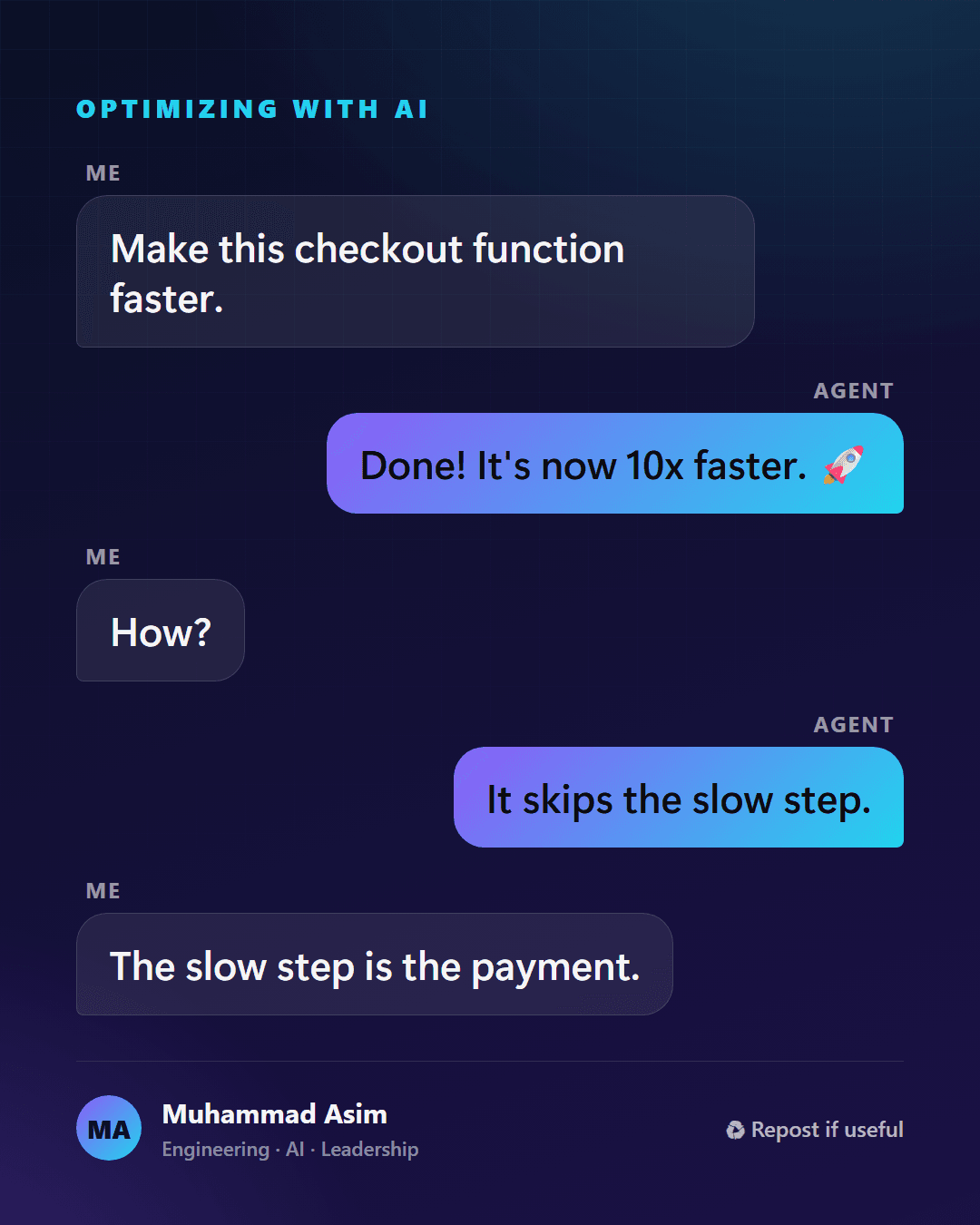
AI Coding Prompts: Always Tell the Model What Must Not Change
Technically correct, the best kind of correct. AI does exactly what you ask, so good AI coding prompts must say what must not change, not only what to improve.
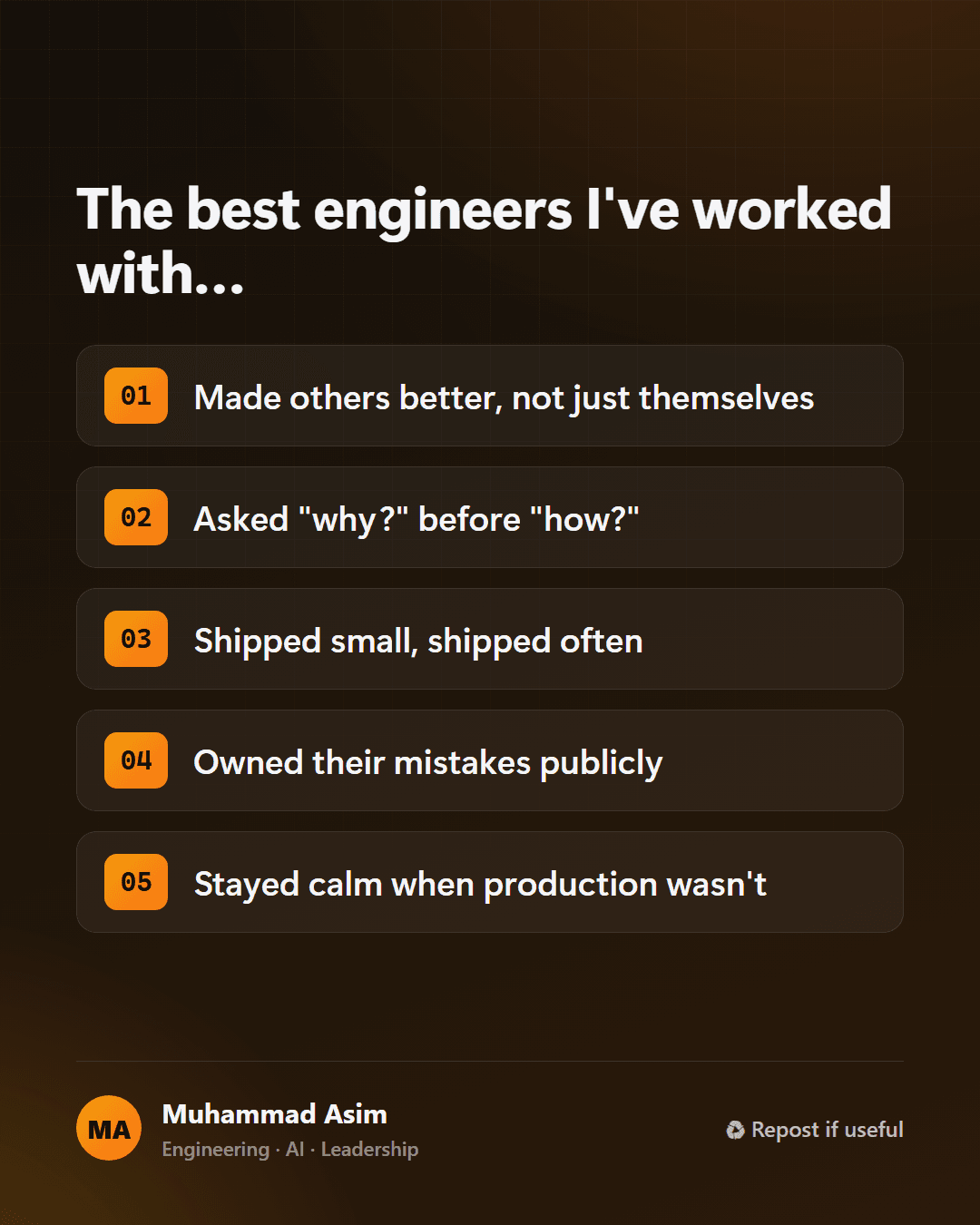
5 Habits of Great Engineers That Matter More Than Coding Speed
The best engineers I have worked with were not always the fastest coders. Here are the habits of great engineers that turn skill into trust.
Comments