Better 1:1 Questions for Managers: Beyond the Status Update
A 1:1 is not a status update. It is the most important meeting a manager has. Yet many one-on-ones turn into a quick run through of tickets that could have been a message. The fix starts with better 1:1 questions, and then with something harder: listening.
Here is how I think about the meeting, the questions that open real conversations and what to do after.
Why 1:1s go wrong
Status updates are easy. They feel productive, they fill thirty minutes and nobody has to say anything uncomfortable. But status already lives in your tracker and your standups. Using a 1:1 for it wastes the one slot where a person can talk about what is really going on.
A good 1:1 is about the person, not the project. It is where you hear about frustration before it becomes a resignation letter, spot a growth goal before someone looks elsewhere and learn what you are doing that makes their job harder.
Five 1:1 questions that open real conversations
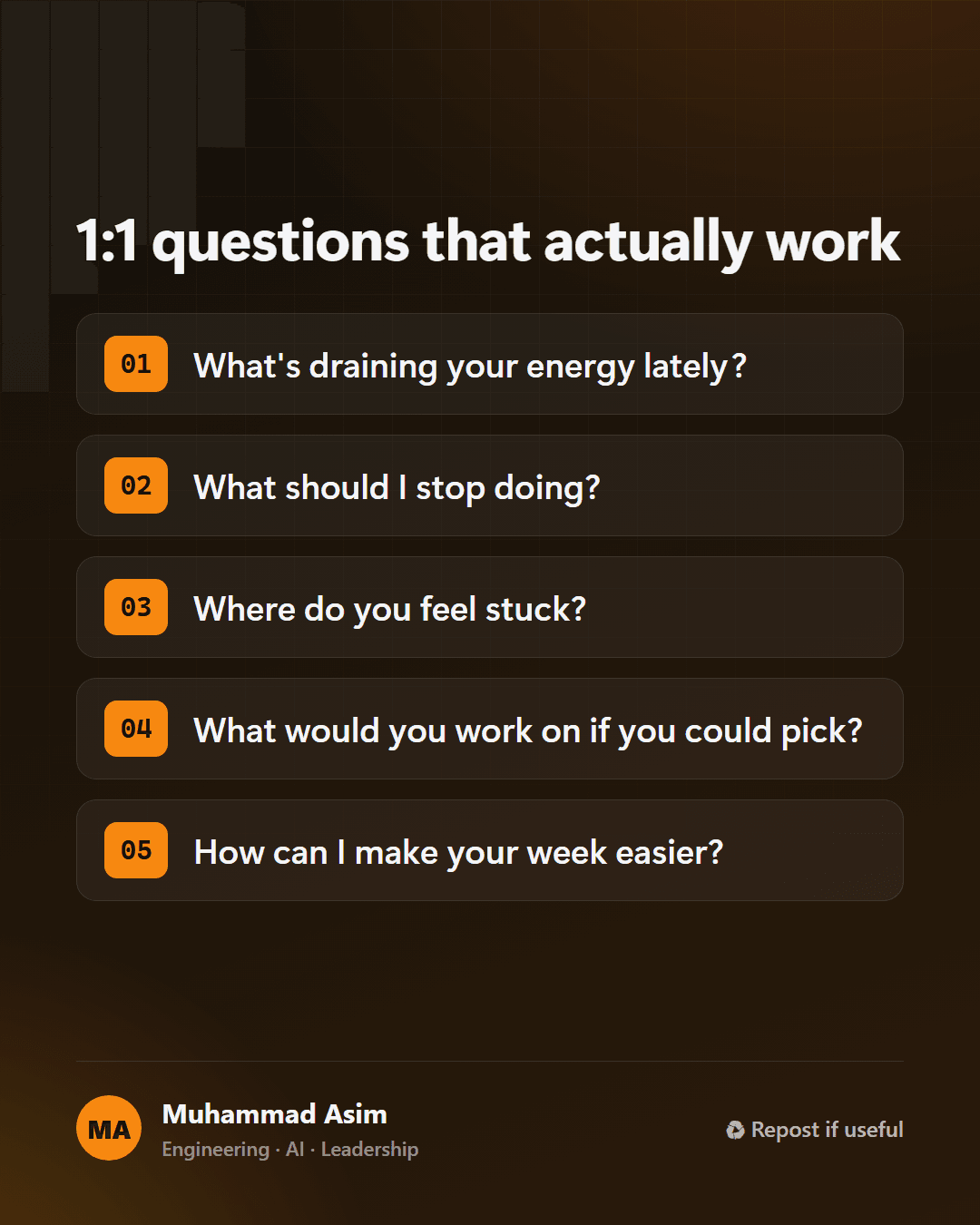
These are the questions I keep coming back to. None of them can be answered with "fine."
"What's draining your energy lately?"
This surfaces problems early. It might be a noisy on call rotation, a difficult stakeholder or a task they dread every week. You often cannot fix everything, but you cannot fix anything you do not know about.
"What's one thing I should stop doing?"
This is the hardest one to ask and the most useful. Asking for "one thing" makes it easier to answer honestly. Be ready to hear it without getting defensive, and thank them, even if the answer stings.
"Where do you feel stuck?"
Stuck can mean a technical blocker, a decision waiting on someone else or a career that feels flat. The question gives permission to talk about any of them.
"If you could pick your next project, what would it be?"
This shows you what motivates them. You may not be able to give them that project tomorrow, but you can keep it in mind when the next opportunity comes up.
"How can I make your week easier?"
Simple, practical and often surprising. The answer is usually small: fewer meetings, a faster decision, a clearer priority. Small fixes build a lot of trust.
The hard part: listen, then follow up
Then the hard part: listen more than you talk, and follow up on what you hear.
Listening means leaving silence after a question. People often need a few seconds before they say the real thing. Resist the urge to fill the gap or jump to a solution. Ask "tell me more" before you offer advice.
Following up is what makes the questions worth asking. If someone tells you what drains their energy and nothing changes, they will stop telling you. Keep short notes, and start the next 1:1 with "Last time you mentioned... here is what I did." Even when you cannot solve the problem, closing the loop shows you heard it.
Practical tips for better one-on-ones
- Make it regular. Weekly or every two weeks, and do not cancel it first when things get busy.
- Let them own the agenda. Keep a shared doc where they add topics first.
- Rotate the questions. Asking the same five every week gets stale. Pick one or two each time.
- Keep private notes on themes, goals and follow ups.
- Talk about growth at least monthly, not just in review season.
- Adjust for remote teams. Turn cameras on if people are comfortable, and watch for signs of isolation. I shared some thoughts on that in Mastering Work-Life Balance in Remote Work.
For new managers
If you have just moved into a lead role, 1:1s can feel awkward at first. That is normal. Start with one or two of these 1:1 questions, take notes and focus on follow up. The trust builds over weeks, not in one meeting.
Coaching new leads through this is part of what I offer as a fractional tech lead, and you can read more about my background on my about page.
The takeaway
The best 1:1 questions are simple, open and focused on the person. But the questions are only half of it. Listen more than you talk, and follow up on what you hear. That is what turns a weekly meeting into the most valuable thirty minutes on your calendar.
Managers, what is your go to 1:1 question? If you want help building strong habits with your leads, get in touch.
First shared on LinkedIn.
Subscribe to my newsletter
Read articles from Tech With Asim | Learn, Build, Lead directly inside your inbox. Subscribe to the newsletter, and don't miss out.
More Articles
Spec-Driven Development: Why Specs Are Back in the Age of AI Agents
With AI agents doing more of the implementation, the quality of your spec decides the quality of your output. Here is how to practise spec-driven development well.
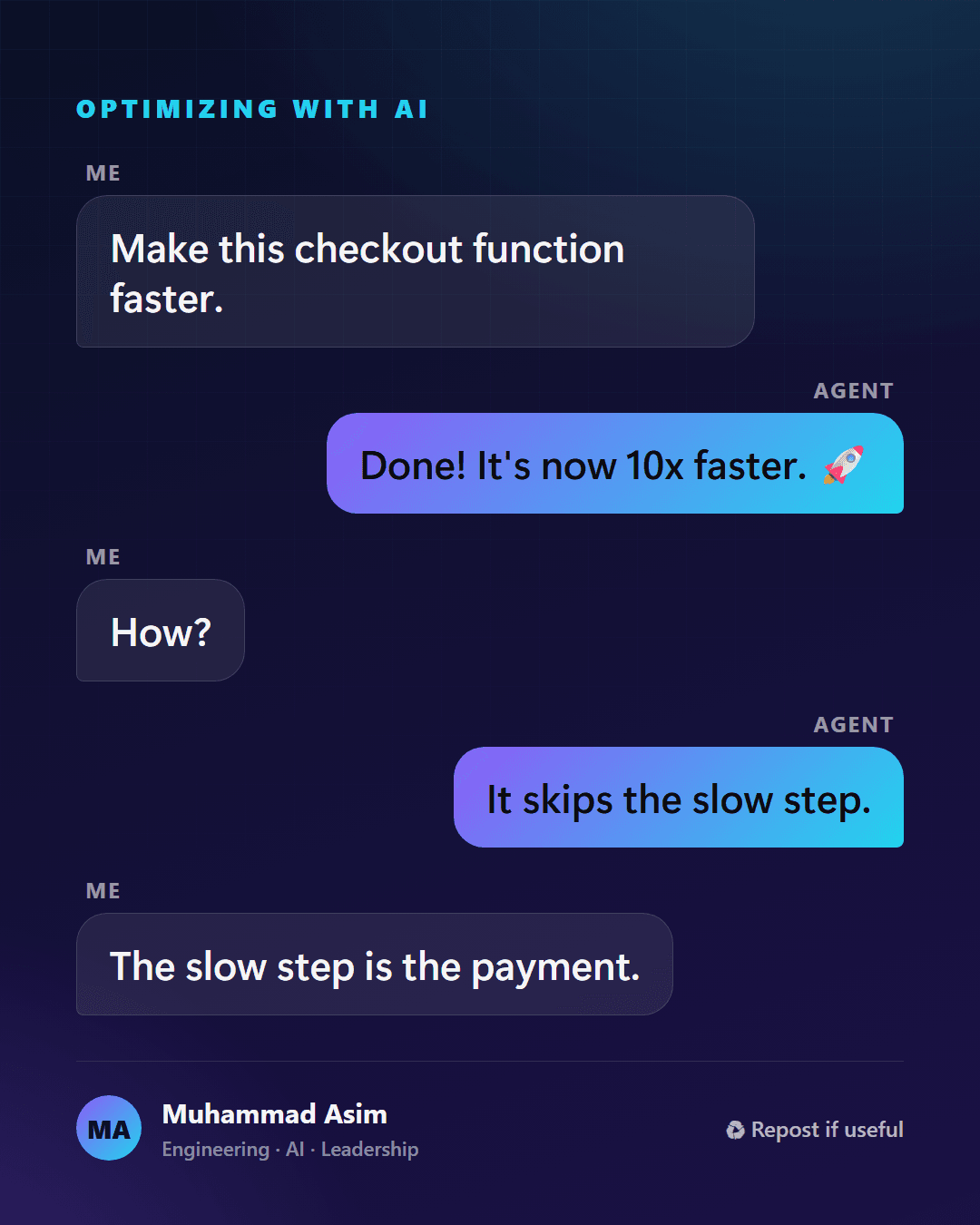
AI Coding Prompts: Always Tell the Model What Must Not Change
Technically correct, the best kind of correct. AI does exactly what you ask, so good AI coding prompts must say what must not change, not only what to improve.
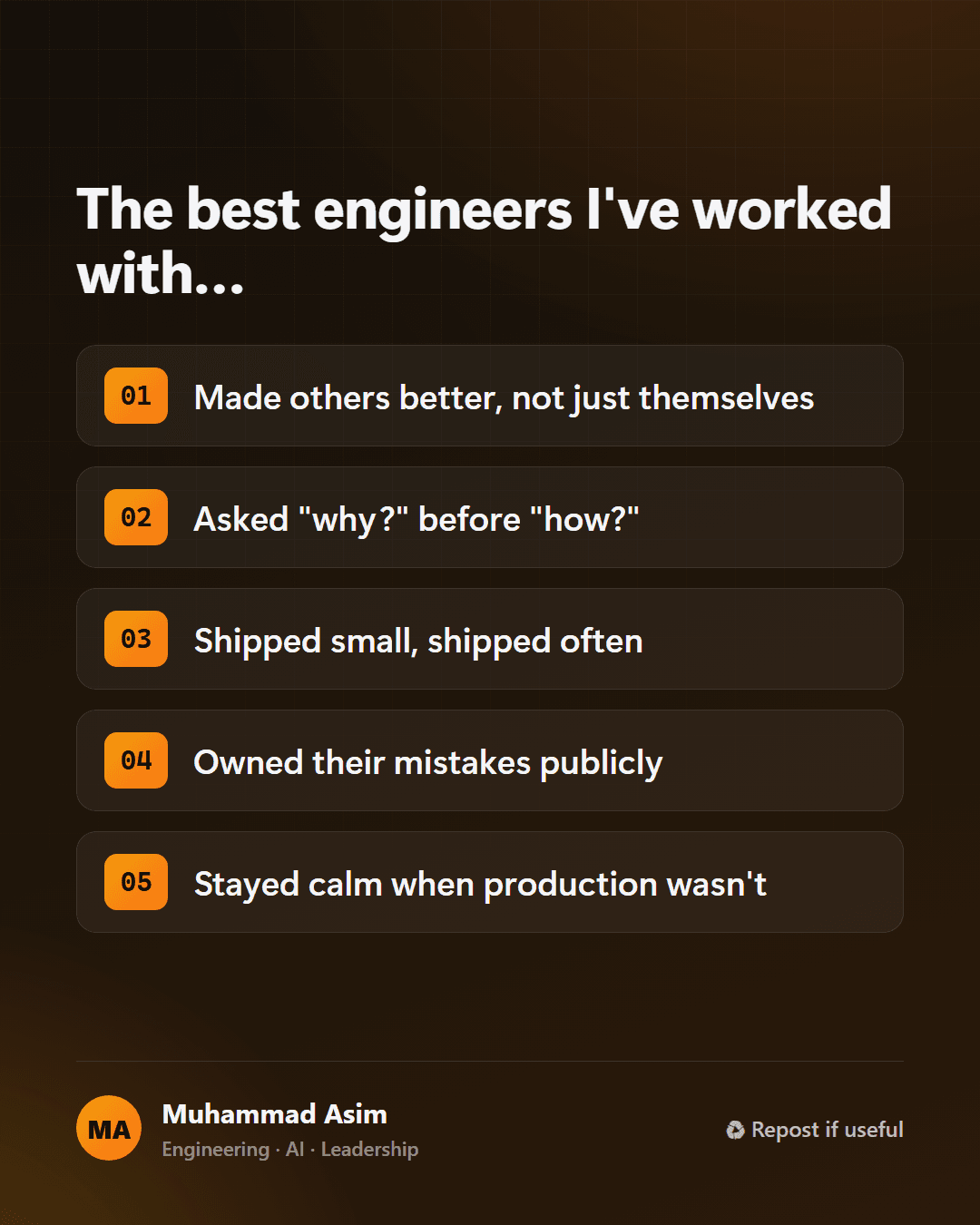
5 Habits of Great Engineers That Matter More Than Coding Speed
The best engineers I have worked with were not always the fastest coders. Here are the habits of great engineers that turn skill into trust.
Comments