An AI Code Security Checklist for AI-Assisted Development
AI writes code fast. Attackers read code fast too. When a team starts using AI agents, the amount of new code goes up, and so does the amount of code that can hide a weakness. That is why every team using AI for development needs a simple AI code security checklist that everyone follows on every change.
AI doesn't make insecure code. Unreviewed code does. The checklist below is about making review and safety part of the normal flow, not an afterthought.
Why AI changes the security picture
AI models learn from huge amounts of public code. Some of that code is excellent. Some of it has old patterns, unsafe defaults or outright bugs. A model can reproduce those patterns with total confidence.
Agents also act more freely than autocomplete. They install packages, edit config files and write scripts. Each of those actions can introduce risk if nobody checks it. None of this means you should avoid AI. It means you should treat AI output like code from a fast, capable new team member who does not yet know your security rules.
The AI code security checklist
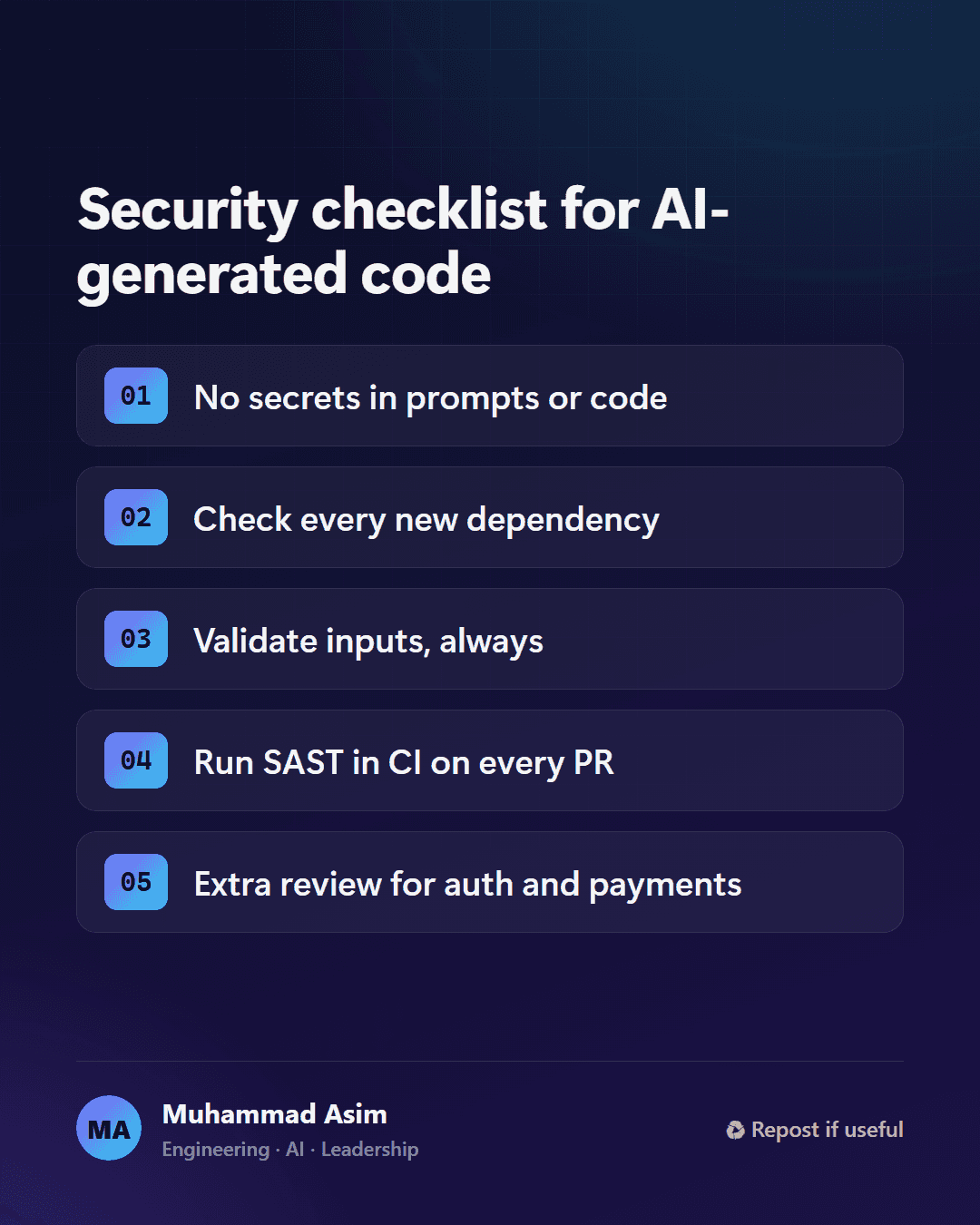
1. No secrets in prompts or code
Never paste API keys, passwords, tokens or connection strings into a prompt. Never let them land in code. Use environment variables locally and a proper secrets vault in your deployed environments. Add secret scanning to your repository so a leaked key is caught before it is merged.
Also think about what you share in context. Prompts may be logged or sent to third-party services, depending on your setup. Treat the prompt as something that could be read by others.
2. Check every new dependency the agent adds
Does it even exist? AI models sometimes suggest package names that sound right but are not real. Attackers know this. They can publish malicious packages under those names and wait. This is a real supply chain risk.
For every new dependency, check that the package is real, maintained, widely used and actually needed. Often the standard library or an existing dependency already does the job.
3. Validate inputs, always
Never trust generated parsing logic blindly. Code that handles user input, file uploads, URLs, queries or data from other systems is where most serious bugs live. Check that inputs are validated, queries are parameterised, output is encoded and errors do not leak internal details. Use a well-known validation library instead of a hand-written regex where you can.
4. Run static security analysis (SAST) in CI on every PR
Humans miss things, especially in large diffs. Static application security testing tools scan code for known dangerous patterns: injection risks, unsafe functions, weak crypto, hard-coded secrets. Run them automatically in CI on every pull request, alongside dependency vulnerability scanning. Make serious findings block the merge.
Automation does not replace review, but it catches the obvious problems so reviewers can focus on logic.
5. Extra human review for auth, payments and personal data
Some areas carry more risk than others. Changes to authentication, authorization, payments and personal data handling should always get a careful review by someone who knows those areas well. Consider requiring a second reviewer for these paths, and mark them clearly in your codebase so everyone knows they are sensitive.
Make it part of your workflow
A checklist only works if it is used. A few ways to make it stick:
- Put the five points in your pull request template.
- Add security rules to your agent's project instructions file, such as "never add a dependency without asking" and "never log secrets."
- Use code owners so sensitive folders automatically request the right reviewers.
- Review the checklist as a team every few months and update it.
I build these guardrails into my AI native engineering workflow, where agents work inside clear limits and every change goes through tests and review. For teams setting up agents, my Claude Code consulting includes this kind of safety setup. Businesses in the region looking for hands-on help can also see how I work as an AI engineer in the UAE.
Quick version to share with your team
- No secrets in prompts or code. Use env vars and vaults.
- Verify every new dependency is real and needed.
- Validate all inputs. Do not trust generated parsing blindly.
- Run SAST and dependency scans in CI on every PR.
- Extra human review for auth, payments and personal data.
Speed is great. Speed with safety is better. If you want help putting this AI code security checklist into practice, get in touch.
What is on your team's AI security checklist?
First shared on LinkedIn.
Subscribe to my newsletter
Read articles from Tech With Asim | Learn, Build, Lead directly inside your inbox. Subscribe to the newsletter, and don't miss out.
More Articles
Small Pull Requests Are Kind Pull Requests: Beating Personal Scope Creep
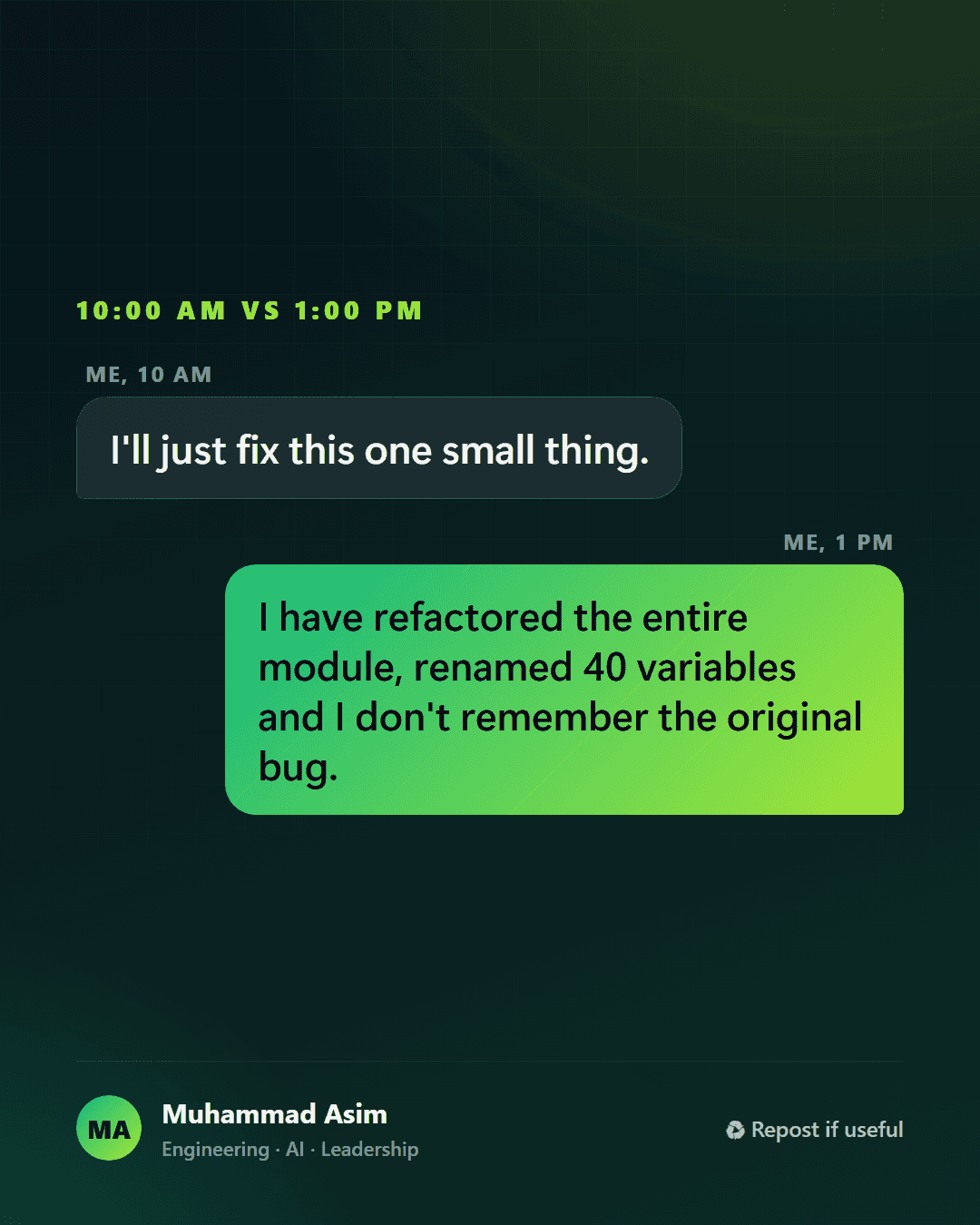
Scope creep, but make it personal. You open a file to fix one line and suddenly you are improving everything. Small pull requests are kind pull requests.
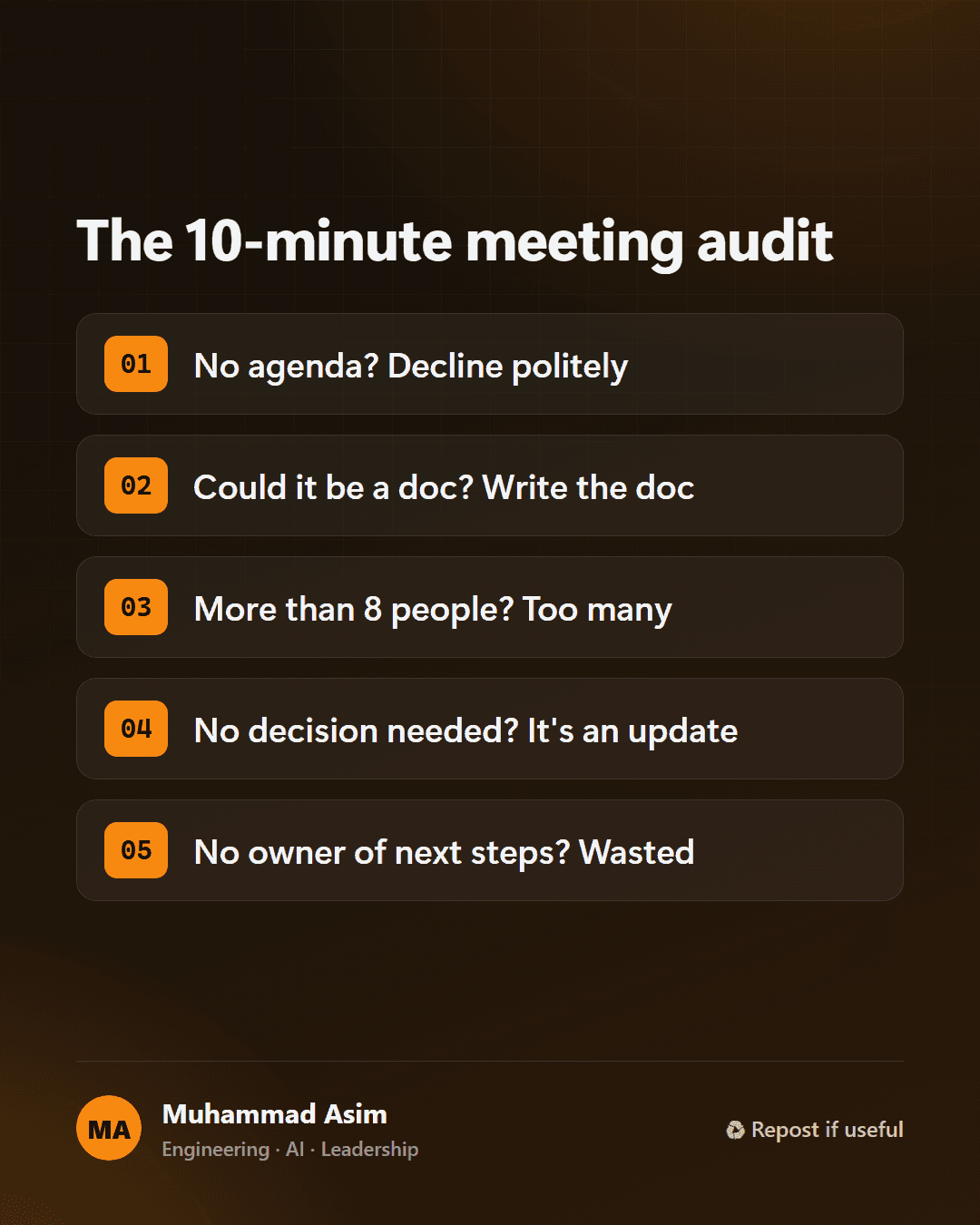
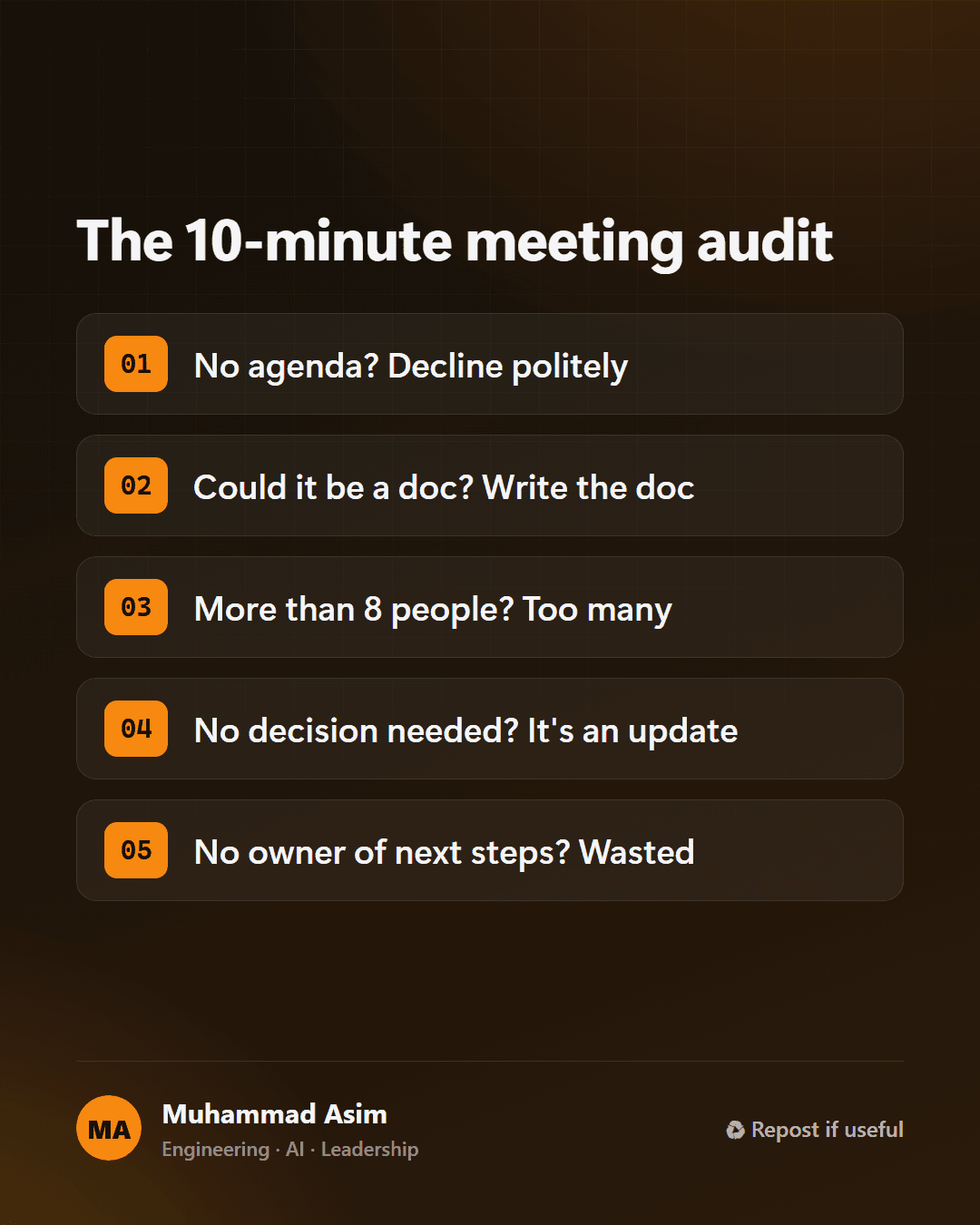
A 10-Minute Meeting Audit to Win Back Engineering Focus Time
Engineers need long blocks of focus, and every unneeded meeting is a tax on your product. A 10-minute meeting audit with five simple questions helps you win that time back.
Spec-Driven Development: Why Specs Are Back in the Age of AI Agents
With AI agents doing more of the implementation, the quality of your spec decides the quality of your output. Here is how to practise spec-driven development well.
Comments